Sunday, May 06, 2012

Project on Government Oversight: Still Shrill After All These Years

Know Your ‘Reformers’: Episode 1 in potentially a long series

Introduction

I’ve been toying for quite some time with the idea of maybe taking on a book project: a book about the modern era of so-called “Military Reformers” and the also so-called  ‘Military Reform Movement’. My interests in their activities reaches back to at least the late 70’s. As a byproduct of examining the output of the leading/most prolific ‘reformers’ in detail over the years I’ve managed to consume a great many of their screeds.  I have also acquired a fairly significant selection of their writings not available by other means (such as the internet).  Nearly all of the ‘reformer’ material I have acquired over the years has been either library remainder (free) or (mostly) purchased second-hand. The fine point here is this: as my research progressed and knowledge of the ‘Reformers’ increased, it became increasingly important to me to NOT subsidize their ‘work’ in any way, shape, or form.

Another Generation. Same Old Song and Dance.

In my ‘inbox’ earlier in the week was a link to an interesting piece posted at the Defense Professionals (DefPro) website (Although the publication of same calls the ‘Professionals’ part seriously into question). It is a classic example of the kind of thinking (or lack thereof) that goes into a typical POGO rant, but in this case, it offers the kind of transparency to POGO’s philosophy and modus operandi that I don’t think I’ve seen since Dina Rasor’s early effluences, back when she was cranking up POGO’s prior incarnation: the ‘Project on Military Procurement’.

Ben Freeman.
(A patriotic guy. Just ask him )
Source: POGO
The piece that follows was put together by one of POGO’s newest (and therefore greenest) ‘investigators’, one Ben Freeman, who has been rather prolific of late. The subject this time is the Littoral Combat Ship program, but it could be about almost any program. Indeed, as I read through the piece, which for our purposes Freeman conveniently structured in a ‘he said’-‘she said’ format, I was struck by the similarities in substance and tone that Dina Rasor used when she attacked (yes, a ‘trigger’ word, but that is what it was) the M-1 (tank and program) performance ‘back in the day’ without really understanding what a tank was for much less how it was to be used.  From the obvious parallels, it immediately became apparent that we could also use Freeman’s POGO piece to illustrate clearly the kind of philosophical, conceptual, and technical dissonance that exists between the worlds of those who ‘do’ things in the real world and those who ‘second guess’ from the trench lines of ‘Reformerland’.
Even better, we can accomplish this without having to deal with the more substantial issues of whether or not the LCS program is needed and justified and/or having to dissect the back-story motivations of the ‘second guessers’ for this go around and save just them for another time.
LCS 1 (Left) and LCS 2  (USN Photo)
I now present the DefPro piece in its entirety, with observations/commentary in [red brackets].     

Navy Defends $120 Billion LCS Program, POGO Publishes Rebuttal

08:27 GMT, May 2, 2012 POGO certainly caused a stir last week after sending a letter to U.S. Congress reporting that the USS Freedom, the first ship commissioned under the Navy’s Littoral Combat Ship (LCS) program, has been plagued with cracks, flooding, corrosion, and repeated engine failures. In response to POGO’s letter, Rep. Duncan Hunter (R-CA) amended the National Defense Authorization Act, “demanding that the Navy ‘fess up to Congress on problems with its Littoral Combat Ship,” according to AOL Defense. [First, note the self-promoting claim of causing a ‘stir’; we’ll get back to it later. The most interesting thing is how the quotation is used. If not read carefully, it might lead one to believe that Rep. Hunter was the one quoted, rather than a turn of a phrase that the author of the AOL piece -- one Sidney J. Freeberg Jr.-- used to punch up the opening of his article.]  
Hunter confirmed that our letter was the impetus for the amendment. “I didn’t realize the Navy had been so restrictive in its reporting even with DoD,” Rep. Hunter told AOL Defense. “We just want to know what’s going on.”

[Again, a carefully deceptive use of selective quotation.  One that rather carefully does NOT mention a more substantial quote a couple of paragraphs ahead of the ‘punchline’ Freeman lifted from Freeberg’s article. If Freeman had included the more explanatory quote ahead of this one, we would have read: "This simply makes the navy come to us and explain all the problems [and] all the good things about the LCS we need to know to conduct proper oversight," Rep. Hunter told the committee. "The Navy needs to be more forthcoming with us." But perhaps that more balanced description would have set the ‘wrong’ tone for what will follow? The claim of confirmation that POGO’s letter was the ‘impetus for the amendment’ is classic POGO: 
1) make claims where is not important whether or not they are ‘valid’, only that they cannot be ignored by legislators or administrators without risking escalation and appearance of indifference/malpractice.
2) Legislators/administrators move to at least pretend to examine the claims to avoid further complaint.
3) POGO then markets their activities as a ‘success’. “POGO gets results!” (as in the claim to have caused ‘a stir’)
Note: Expect mention of this ‘success’ in future POGO fundraising briefings/pleas to preserve and expand their donor base.]       
Rep. Hunter is joined in this bipartisan push for oversight of the LCS program by fellow House Armed Services Committee Members Hank Johnson (D-GA), who issued a statement supporting Hunter’s amendment, and Jackie Speier (D-CA), who sources confirm will be issuing LCS legislation of her own. And just yesterday, The Hill reported that Senators Carl Levin (D-MI) and John McCain (R-AZ), the Chair and Ranking Member of the Senate Armed Services Committee, respectively, have called for a Government Accountability Office (GAO) review of the program.

It all seemed to touch a nerve with the Navy, which quickly moved to defend the $120 billion LCS program, which calls for a new wave of nimble combat ships designed to operate close to shore. The beleaguered Freedom, manufactured by Lockheed Martin, is one of two LCS designs.

[Obviously Freeman is still trying to set up the right POGO vibe here. ‘Touch a nerve’? Will we perhaps see in a short while why a rapid response from the Navy should be considered so ‘remarkable’ or when viewed in context will it be actually ‘unremarkable’?]
The Navy issued a response to our letter so quickly that even Defense News remarked that it was delivered with “uncharacteristic alacrity.”

[Again, setting up the idea that the ‘Navy’ (yes, apparently ALL of it) was ‘unsettled’, by the machinations of the (apparently) ‘mighty’ POGO? If the previous comments serve any purpose other than casting the Navy in a less than flattering pose, it is not exactly clear what  they are here for, or otherwise why they would have been included in this POGO piece at all.]

One point the Navy protests is our statement that LCS ships will make up as much as half of the Navy’s surface fleet. The Navy cites a report to Congress that says the LCS will account for 22 percent of the “21st Century Battle Force.”

We can admit when we’re wrong. But in this case the “22 percent” the Navy cites is not accurate, either. The planned 55 LCS ships will account for 38 percent of the Navy’s surface combatant ships.

[So. POGO takes issue with the Navy’s ship count numbers. Is it because POGO has a better list of ships, more authoritative definitions of what constitutes a ‘surface fleet’ or ‘battle force’, or a better grasp of naval force plans than the Navy itself? Why is this example of what is really ‘communication at cross purposes’ included in this piece at all?  I think we are again left with the perception of some deceptive, and IMHO rather pissy, ‘battlefield prep’ on the part of POGO’s Freeman.]  
As for the rest of the Navy’s response to our letter, we’ll beg to differ and stand by our work.
Here’s a side-by-side comparison of the Navy’s response and our rebuttal:
[Finally!]
WHAT OUR LETTER SAID:
“Senior Navy officials have publicly praised the LCS program. However, the Navy has been reluctant to share documents related to LCS vulnerabilities with entities such as the Pentagon’s Office of the Director of Operational Test and Evaluation (DOT&E).”
• The Navy’s Response:

This is not correct. The LCS Program Office has been working in close coordination with the DOT&E community since the early days of the program. DOT&E has been an active member of the T&E Working level Integrated Program Teams (WIPTs) since 2004 and most recently at the [Office of the Secretary of Defense (OSD)] level in the milestone-related Integrating IPTs (IIPTs) and Overarching IPTs (OIPTs) that occurred in 2011. Draft Detail Design Integrated Survivability Assessment Reports (DDISAR) were provided to DOT&E in the second quarter of fiscal 2012 to initiate discussions while modeling results and shot line selections are completed. DOT&E is working with the program office to complete the DDISARs and move toward developing Total Ship Survivability Trials (TSST) plans that assess Seaframe survivability in fiscal 2014. DOT&E will receive the final DDISARs prior to the planning and conduct of the TSSTs. Additionally, the LCS Program Office provided a draft of the 57mm Live Fire Test and Evaluation Management Plan to OSD/DOT&E on 29 March, and received comments on 3 April 2012. Comment resolution is in process.
• Our Rebuttal:

The only two documents the Navy confirms sharing with DOT&E are a “draft of the 57mm Live Fire Test and Evaluation Management Plan,” and a draft of the “Detail Design Integrated Survivability Assessment Reports.” Both of which were just recently received by DOT&E. As our letter indicates, the Navy possessed several documents related to the ship’s performance and equipment failures that it failed to share with DOT&E. Plans to create trials in 2014 do nothing to improve oversight of a ship that will be deployed to Singapore in 2012.
[Got that? First POGO accuses the Department of the Navy with not being forthcoming with DoD’s DOT&E organization using the unbounded term ‘reluctance’ to describe LCS document sharing concerning the LCS’s ‘vulnerabilities’ . In response, the Navy points out that DOT&E representatives are embedded participants within the LCS test community, and lists specific LCS Program draft reports that have been submitted on relevant activities (to the ‘vulnerabilities’ topic that POGO highlighted). It is also apparent from the statement these reports are being submitted on an event-driven schedule.
POGO’s ‘rebuttal’ ? Freeman chooses to ignore the statement concerning ongoing DOT&E participation with the cognizant LCS Test &Evaluation IPT, then Freeman carps about the low number of reports acknowledged to have been shared by the Navy. Does POGO/Freeman really feel entitled to a comprehensive list of communications between the Navy and DOT&E based upon a ‘letter’ they wrote, or are they just keeping on the offensive as the best form of defense? (The latter could be described as a typical ‘reformer’ move BTW: think Boyd’s OODA Loop)
LCS 1 USS Freedom replenishment with LHD 6 USS Bonhomme Richard  (USN Photo)
In this case though I believe the former was more ‘wished for’ than expected. This appears more likely to be, in the best POGO/Reformer tradition, a case of asking for information and then making the next move based upon the response. 1) If the information requested is not provided, make assertions of ‘reluctance’ (the cycle on this path eventually ramps up to accusations of ‘coverup’ or worse). 2) If the information requested IS provided, then interpret it to support the agenda in hand.

The ‘tell’ this time is the importance Freeman mentioning “several documents related to the ship’s performance and equipment failures that it failed to share with DOT&E”. Aside from the inflammatory ‘failed to share’ phrasing, from a systems Reliability, Maintainability and Availability (RM&A) point of view, it would be fundamental nonsense to analyze failure data and draw any final conclusions as to failure significance or trends, and in some cases even root cause, this early in a program. The mixing of complaint about structural performance and system performance is either shotgunning the target hoping to hit something, or indicative that like many ‘reformers’ Freeman doesn’t know enough to distinguish between the two. Modern complex systems typically require tens of thousands of operating hours before system reliability can be ‘graded’ against specifications.  The only purpose for outside and uninformed interests to acquire such data this early is for target practice and laying groundwork for further misadventures in furthering their agenda. 
WHAT OUR LETTER SAID:

– “… (LCS-1, the first LCS ship) has been plagued by flawed designs and failed equipment since being commissioned, has at least 17 known cracks.”

– “Before and during the ship’s second set of rough water trials in February 2011, 17 cracks were found on the ship’…”
– “Another crack was discovered “below the waterline and is currently allowing water in... When discovered there was rust washing onto the painted surface. It is thought this is rust from the exposed crack surface. It is unknown how long this crack existed prior to being discovered.”

– “Similarly, cracks in the deck plating and center walkway on the port side were mirrored by corresponding cracks on the starboard side. Fifteen experts, including a source within the Navy, have informed POGO that the cracks in nearly identical locations on opposite sides of the ship may be indicative of systematic design issues.”
– “Last May, the LCS program manager issued near term operating guidance for LCS-1, which placed significant constraints on the ship’s safe operating envelope (SOE).”

– “Specifically, the new guidance states that in rough water (sea state 7; 19.5- to 29.5-foot waves) with following seas, the ship cannot travel at speeds greater than 20 knots, and cannot travel into head seas at any speed. Even in calmer seas (sea state 5; 8.2- to 13.1-foot waves) the ship’s peak speed into head seas is capped at 15 knots, relegating the Navy’s “cheetah of the seas” to freighter speeds.”

• The Navy’s Response:

Speed restrictions for LCS 1 have been lifted. With regard to the cracking discussion, these are not new findings. LCS 1 has experienced minor structural issues. The details of the cracks found on LCS 1 were briefed to the defense committees, including the Senate Armed Services Committee (SASC) over a year ago (March 2011). All repairs were conducted using approved repair procedures and satisfactorily inspected by American Bureau of Shipping (ABS) and the appropriate Naval Technical Authority. Thorough analyses and reviews of the designs and construction documentation were conducted, with the goal of improved production processes. Design changes, as necessary, have been incorporated in future hulls to resolve noted issues. Production processes were modified as needed, to prevent future issues. These design changes were implemented into LCS 1 throughout her post delivery period, the ship has been approved to operate with the full scope of the approved Safe Operating Envelope (SOE) since completion of the repairs.
• Our Rebuttal:
The Navy’s claim that the cracking issues have been reported is partially correct. The cracks were reported, but the extent of the cracking was not. These cracks have been repaired, but the cracking problem continues according to sources close to the program. Faulty welds and construction continue to cause new cracks on the ship that the Navy has yet to report.

The Navy also claims “the ship has been approved to operate within the full scope of the approved Safe Operating Envelope (SOE) since completion of the repairs.” But, being approved to operate within the full scope of the SOE and actually operating are completely different. The simple fact is that since completion of these repairs the ship has been unable to successfully perform at the upper end of its SOE.
[POGO first makes a litany of assertions related to structural cracks and their consequences, including a rather humorous appeal to authority  in employing ‘Fifteen experts’ stating a rather obvious  factoid ‘may’ be true. One would think one expert would have sufficed for such a weak assertion of something not likely to be disputed. Once you get past the unintended humor, the first questions that come to my mind are:
1) Is the discovery of the need to make structural tweaks a normal part of wringing out a new ship?
2) Is the scope and impact of the cracking to date typical, lower or higher than might be reasonably   expected?
3) Does the Navy (or ship builders in general) employ a methodical strategy for identifying, tracking and fixing structural issues/problems?
4) If they do not, why isn’t POGO raising a holy stink over the absence of same?

But we don’t need to get too deep into the topic of what the norms are because of the Navy response: Ummm. We fixed all those problems.

POGO’s rebuttal: There’s more problems that have occurred, and an unsupported assertion that the LCS in question has been unable to ‘perform at the upper end’ of its operating environment, which even if true, from the sound of it this is unrelated to structural problems, so why bring it up at all on this subtopic, except as sort of a ‘yes but’ deflection? ] 
WHAT OUR LETTER SAID:

“From the time the Navy accepted LCS-1 from Lockheed Martin on September 18, 2008, until the ship went into dry dock in the summer of 2011 — not even 1,000 days later — there were 640 chargeable equipment failures on the ship. On average then, something on the ship failed on two out of every three days.”

• The Navy’s Response:
As with any ship, all equipment failures on LCS 1, regardless of how minor the impact to mission, have been meticulously tracked, and this data has been invaluable in improving the reliability of ship systems. The 640 chargeable equipment failures from Ship Delivery until the summer dry docking, tracked in the LCS 1 Data Collection, Analysis, and Corrective Action System (DCACAS) represent all equipment failures to the ship for all systems (propulsion, combat systems, auxiliaries, habitability, C4I, etc) regardless of whether the equipment was repaired by the crew or off ship maintenance personnel.
The 640 failures referenced include multiple failures on a piece of equipment (38 for the Main Propulsion Diesel Engine) and single failures to equipment (one Man Overboard Indicator). From the DCACAS report dated 31 Aug 2011, approximately 12 percent of the equipment failures since delivery can be attributed to the Ship Service Diesel Generators (SSDGs). In May 2010 the Navy and Lockheed Martin instituted a Product Improvement Program for the SSDG. The resulting effort increased Mean Time Between Failures (MBTF) for the equipment from less than 150 hours (October 2008) to over 500 hours (April 2011).
This is a case of how the DCACAS data is used to improve the reliability of the ships early in the acquisition program. Overall the DCACAS data is a mechanism to evaluate every failure on the ship to determine if it can be attributed to infant mortality of the equipment, normal wear and tear for that equipment/component, or is a trend that needs to be addressed via design changes or reliability growth efforts.

• Our Rebuttal:
The Navy does not dispute the 640 failures, which had not been previously reported. The Navy mentions that the DCACAS data is used to determine if failure can be attributed to infant mortality, normal wear and tear, or is a trend. Their file confirms that nearly a third of these failures were potential or confirmed trends, which, according to the Navy should “be addressed via design changes or reliability growth efforts.” This is precisely our rationale for questioning this ship’s design.

[ POGO’s Freeman first commits the ‘fundamental nonsense’ I mentioned earlier. The Navy pretty much responds as if helping a child with their color matching skills. Freeman double-downs on the 640 failures as not being reported’ yet they must have been reported somewhere for Freeman to have been aware of them. Then Freeman takes the point that the Navy notes that failures where trends have been identified (obviously either simple systems or related to simple installation, or operating factors or problems anticipated via earlier analysis and test) should “be addressed via design changes or reliability growth efforts”. Freeman then makes the illogical claim that the existence of problems, the scope of which he has failed to establish are truly worrisome or even out of the expected norm “is precisely our rationale for questioning this ship’s design”. 
The fact that Freeman believes technical problems or issues arising on the introduction of a new weapon system (on which he has no expertise or just as important, no experienced perspective to judge the significance of) into its operating environment SHOULD give him cause to be “questioning this ship’s design”, would normally cause the recreational sailor in me to suspect that Freeman apparently has never been around a ‘boat’ much less a ‘ship’ long or often enough to be a proper judge of ship systems reliability and performance, and this last passage would seem to be evidence enough to suspect his qualifications to even ask the RIGHT questions concerning same.
EXCEPT…

LCS 2 Under Construction (GD/Austal Photo)
Except if you know how ‘reformers’ work, you would realize that this kind of faux indignance is their bread and butter.  Good engineers and program managers understand the challenges of complexity and can distinguish between necessary and unnecessary complexity, and they even know there is room for disagreement on same, one of the reasons for the term: Best Engineering Judgment.  Engineers and program managers know there will always be technical problems to solve when fielding any complex (and even simple) system. Engineers and program managers know that sources and remedies to the technical problems may be found in the design, the construction, the integration, or even the training and education of the operators. Engineers and program managers know that until you actually field a system--complex or simple--you will NEVER know about all-- much less be able to preclude all-- potential technical problems. Good Engineers and program managers see a technical problem as to be expected and solved. So-called ‘Reformers’ see technical problems as simply reasons to do something other than what is being done, something to be used in furthering their own agendas. And those agendas may or may not be what is publicly stated, but they are never FOR advancing a weapon system under development. ]  

WHAT OUR LETTER SAID:
“Secretary of the Navy Raymond Mabus told the Senate Armed Services Committee in December 2010 that both variants of the LCS were performing well, and that “LCS–1, the Freedom, demonstrated some of the things we can expect during her maiden deployment earlier this year.” Then-Chief of Naval Operations Admiral Gary Roughead echoed this praise for the LCS-1, stating “I deployed LCS earlier than any other ship class to assure we were on the right path operationally. It is clear to me that we are.”

• The Navy’s Response:
USS FREEDOM (LCS 1) arrived in San Diego on April 23, 2010, successfully completing her maiden deployment more than two years ahead of schedule and three to five years faster than conventional ship acquisition strategies. LCS 1 traveled 6,500 miles, transiting the Panama Canal. Highlights of operations in 3rd and 4th Fleet Areas of Responsibility include theater security cooperation port visits in Colombia, Panama, and Mexico, successful performance of strike group operations with the USS Carl Vinson Carrier Strike Group, joint maneuvers with the Mexican Navy, and counter-illicit trafficking patrols which resulted in 4 interdictions yielding over 5 tons of cocaine, 2 seized vessels, and 9 suspected smugglers taken into custody. The second phase of the early deployment included LCS 1 participating in the bi-annual Rim of the Pacific (RIMPAC) exercise with 14 other nations, 34 ships, 5 submarines, 100 aircraft and over 20,000 personnel. The early deployment included the development of a coordinated logistics support plan. The lessons learned from the LCS 1 deployment have provided critical data to inform the permanent support plan for the 55 ships of the LCS class, as well as valuable information used in the construction of both LCS 3 and the Block buy ships.

• Our Rebuttal:
These quotes are not an “issue” that we raised. We mentioned them in context of the ship’s failures to show the disconnect between what Navy officials were telling Congress and what was actually happening on the ship.

[No. To be accurate, you might reasonably claim you “mentioned them in context of” of what POGO views as “the ship’s failures” in an attempt “to show” what POGO asserts is “the disconnect between what Navy officials were telling Congress and what” POGO views as “was actually happening on the ship”.
WHAT OUR LETTER SAID:

“Mabus and Roughead failed to mention that during the approximately two-month deployment when the ship traveled from Mayport, Florida, to its home port in San Diego, California, there were more than 80 equipment failures on the ship. These failures were not trivial, and placed the crew of the ship in undue danger. For example, on March 6, 2010, while the ship was in the midst of counter-drug trafficking operations and reportedly “conducted four drug seizures, netting more than five tons of cocaine, detained nine suspected drug smugglers, and disabled two ‘go-fast’ drug vessels,” there was a darken ship event (the electricity on the entire ship went out), temporarily leaving the ship adrift at sea.”
• The Navy’s Response:

Throughout its deployment, LCS 1 safely operated and conducted its mission. Few of the 80 equipment failures cited above were mission critical. The ship did experience a brief loss of power, however, it should be noted that many commercial and U.S. Navy vessels have periods of power loss due to plant set-up and operator control. In the event of power loss, there are specific U.S. Navy procedures documented in the Engineering Operational Sequencing System (EOSS) to quickly restore power throughout the ship. To address concerns documented with electric power generation, the LCS Program executed Electric Plant Reliability Improvement Programs on both ship designs to increase reliability of ship service diesel generators and the performance and management of the shipboard electrical systems. This has resulted in changes that have been implemented through post-delivery availabilities on LCS 1 and LCS 2 as well as captured for LCS 3 and follow ships. Additionally, sensors were installed to monitor performance trends.

• Our Rebuttal:
The Navy confirmed “the ship did experience a brief loss of power” while deployed, which again had not been previously reported or shared with Congress in any public testimony. In addition, the Navy claims that, “Throughout its deployment, LCS 1 safely operated and conducted its mission. Few of the 80 equipment failures cited above were mission critical. The ship did experience a brief loss of power…” The fact that other ships lose power does nothing to lessen the danger of unexpected power outages on a ship the Navy would have us believe can survive naval warfare.

In other words, the Navy admits there were mission critical failures, including a brief loss of power, on this LCS-1 mission. This stands in stark contrast to Secretary of the Navy Ray Mabus telling Congress that this mission was a success and the ship “demonstrated some of the things we can expect.” Unless we are to expect rampant equipment failures, it appears that the Navy was misleading Congress about these issues.

[POGO says: Problems BAD! USN says: Problems Typical and Unremarkable. POGO says: Navy BAD for not reporting Typical and Unremarkable problems.

This reads more like POGO trying to manufacture the appearance of a cover up than anything else.]

WHAT OUR LETTER SAID:
“According to the DoD’s DOT&E FY 2011 Annual Report, the LCS is “not expected to be survivable in a hostile combat environment.”

• The Navy’s Response:
The LCS Ships are built to meet Joint Requirements Oversight Council-approved survivability requirements and include OPNAVINST 9070.1 Level 1 Survivability standards [note: OPNAVINSTs are instructions issued with the office of the chief of naval operations]. The LCS design specifically includes Level 1 plus additional tailored survivability enhancements (“Level 1+”). LCS survivability depends on a combination of ship design, ship numbers, and ship CONOPS [concepts of operations] which says LCS will:
– Operate as part of a networked battle force
– Conduct independent operations only in low to medium threat scenarios
– Operate as part of a networked battle force operation in high threat environments
– Create Battle Space/Avoid being hit
– Rely on networked battle force for threat attrition
– Rely on overboard systems
– Fight and survive if hit
– Ship design: Accept ship mission kill; keep ship afloat and protect crew after hit
– Battle force design: Maintain battle force fight-through capability through LCS numbers and mission flexibility
– Withdraw/reposition if hit

LCS is designed to maintain essential mobility after a hit, allowing the ship to exit the battle area under its own power. The LCS systems allow ship’s crew to navigate and communicate while repositioning after a hit all the while utilizing numbers (of LCSs), and CONOPS as force multipliers. LCS incorporates survivability systems to perform required missions in the littoral with an emphasis on crew survival.

• Our Rebuttal:
The Navy again confirms that the LCS has a “Level 1+” survivability rating. According to the Navy “Level I represents the least severe environment anticipated and excludes the need for enhanced survivability…in the immediate area of an engaged Battle Group or in the general war-at-sea region.” In other words, the ship is not expected to survive a true battle at sea. Additionally, given that the littoral combat ship will, by definition, be operating close to shore, it is also extremely vulnerable to land-based attacks, which it is ill-equipped to defend against.

The Chief of Naval Operations Admiral Greenert recently said the LCS was not prepared to “challenge the Chinese military” and you can’t “send it into an anti-access area.”
In short, this is a surface combatant that can’t truly engage in surface combat.

[POGO: DOT&E Report says ship not survivable, USN: Ship designed to be survivable where and when used as intended and BTW: here’s how, POGO: But the Navy can’t use it this other way-- so it doesn’t count. Neener Neener.
BTW: You just gotta’ love the ‘reformer’ chutzpa in rolling out their own definition of surface combat and insisting it overrides that of the USN’s.]

WHAT OUR LETTER SAID:
“Sources close to LCS-1 have now told POGO that after more than six months in port, the ship has been back to sea just twice. The sources also informed us about critical problems that surfaced on the ship during those two outings: several vital components on the ship failed including, at some point in both trips, each of the four engines.”

• The Navy’s Response:

LCS 1 had one of two gas turbines engines fail after over three years of operations (including post-delivery testing, fleet operations and ship early deployment). The root cause analysis of the engine failure revealed that the gas turbine intakes were allowing salt spray to be ingested into the engine intake structure during high seas evolutions, which lead to the eventual failure of a high pressure turbine blade. The salt water did not induce corrosion internal to the engine. However, it changed the air flow through the engine, which eventually led to the failure. As a result of the failure, a redesign of the intake structure along with improved mating seals was implemented on LCS 1 on post delivery and is in-line for LCS 3 and subsequent ships.
• Our Rebuttal:

The Navy does not dispute these previously unreported engine failures. They only discuss the results of an engine failure that occurred in 2010, which we do not mention in our letter.

[The USN blew off what smelled like a POGO fishing expedition, POGO doesn’t like it. That doesn’t make POGOs claims true or accurate and it doesn’t mean the USN even knew for certain what POGO was talking about (which would be just as valid a reason to not respond to POGO as any).]
WHAT OUR LETTER SAID:

“In addition, there were shaft seal failures during the last trip, which led to flooding.”
• The Navy’s Response:

During February 2012 sea trials LCS 1 suffered a failure of the port shaft mechanical seal (1 of 4 such seals). The remaining underway portion of the sea trial was ended and the ship returned to port unassisted. The failed boost shaft stern tube seal was analyzed by independent third party to gain insight into the failure. Repairs to the Port Boost Stern Tube Seal have been completed and the USS Freedom undocked on April 7. All other stern tube seals on FREEDOM were inspected and found not to have this issue. Due to manufacturing timelines and differences, it was determined that LCS 3 seals were not at risk of the same issue. In addition, LCS 3 seals have undergone extensive operation without failure.
• Our Rebuttal:

The Navy reports that shaft seals on the other engines of LCS-1 and those on LCS-3 were not at risk of this same failure. However, prior to this incident, the Navy was not aware the shaft seal that blew was at risk of failing either. [This is an incredibly stupid paragraph, isn’t it? What’s the difference between before and after? Hint: the Navy looked for the problem elsewhere after it occurred once. The Navy must understand the failure for them to state there is no risk for the same failure after looking at the rest of the seals.]

In short, the Navy has not taken any corrective action in response to this issue.

[POGO: Seal Problem! USN: After looking closely, seal failure seen as a onetime thing. Seal repaired! POGO: We don’t know the difference between a ‘repair’ for what appears to be a onetime issue and something that has to be fixed for all the ships (so we want to see a ‘corrective action’ plan?).
WHAT OUR LETTER SAID:

“The DOT&E’s FY 2011 Annual Report states that “[t]he program offices have not released any formal developmental T&E reports.” The report goes on to state that “the Navy should continue to report vulnerabilities discovered during live fire tests and analyses. Doing so will inform acquisition decisions as soon as possible in the procurement of the LCS class.”

• The Navy’s Response:
The Navy is actively developing the required reports documenting the results of all the Developmental Testing that has occurred on LCS 1. Once completed, these reports will be delivered to DOT&E as required.

• Our Rebuttal:

The Navy confirms the DOT&E’s statement, which we referenced in our letter, that “[t]he program offices have not released any formal developmental T&E reports.” In fact, the Navy’s response to this specific critique confirms that “the required reports documenting the results of all the Developmental Testing that has occurred on LCS 1” have not been completed. The Navy states that they will be delivered to DOT&E once they are, but offer no explanation as to why they have not been completed.
[Back to the ‘reports’ bleat eh? Notice how POGO conflates the fact there are no formal reports yet per 2011 DOT&E SAR, but conveniently fails to mention whether or not there were supposed to be any formal reports.  Now, if one bothers to actually read the report without bias, the reader will see that noting the absence of formal reports is not a critique, but a simple observation.  How typically ‘reformer’ of Freeman and POGO to twist facts to satisfy their purposes. ]

It is not unreasonable to ask the Navy to provide testing and evaluation reports for a ship that is scheduled to be deployed to Singapore and has already been deployed in the Caribbean. If the ship is performing as well as the Navy claims they should be eager to provide these reports.

[The assertion of belief as fact: more typical ‘reformer’.
Let’s correct this last paragraph:


POGO BELIEVES it is not unreasonable to ask the Navy to provide testing and evaluation reports for a ship that is scheduled to be deployed to Singapore and has already been deployed in the Caribbean. POGO BELIEVES if the ship is performing as well as the Navy claims they should be eager to provide these reports.

There, all better. ]

WHAT OUR LETTER SAID:

“The Navy has also repeatedly made significant changes to the program while giving Congress little time to evaluate these changes.”
• The Navy’s Response:

Configuration change management has been a key factor in controlling program cost. After incorporation of lessons learned from the lead ships into follow ships, the Program Office has controlled the design baseline closely in order to manage risk and cost.
The Program Office has captured and continues to capture data from these “first of class” vessels. The “first of class” discussion is an important perspective to add. USS Freedom (LCS 1) and USS Independence (LCS 2) not only are they “first of class” vessels but they were procured using research and development funds in a manner outside the bounds of previous ship programs. Previous combatant procurements leverage off of years of research and development, integration testing and validation of systems using surrogate platforms. Aegis Cruisers implemented a new combat system that was tested for over ten years on surrogate ships to a hull form that had already been tested and delivered. Aegis destroyers laid the same propulsion, power generation and combat system into a new hull form. All of these efforts did not preclude these ships from seeing “first of class” challenges.

The LCS programs however, took measures to instrument and collect data on the hull designs, execute design reviews/design updates and implement those findings into the follow-on awards. In addition, those findings have led to upgrades and changes on LCS 1 and LCS 2 to ensure that these research and development hulls are viable assets.
LCS 1 has traveled more than 65,000 nautical miles since it was delivered to the Navy in September 2008 and continues to meet our expectations.

• Our Rebuttal:

The Navy fails to respond to the actual issue we raised related to Congressional notification of program changes, specifically the shift from a down-select to a dual-award acquisition strategy. The Navy opted to instead discuss the “first of class” challenges on Aegis ships.
It’s true that all first of class ships will have problems. However, the extent and nature of the problems on this littoral combat ship are far more problematic than on other ships. Faulty welds, design, and ship construction are the root cause of many of this ship’s failings. These are not first of class issues; they are basic ship-building issues that appear to have been largely ignored on this ship.

[ Gee. We could have saved a lot of trouble by starting with this exchange.  POGO accuses the Navy of making changes that Congress can’t keep up with.  The Navy could have had some fun and just said “What do you mean?” or “Whose fault is that?’ but instead chose to detail why the LCS program is different. And from the Navy’s response we learn just HOW different the program is from previous programs (I had no idea how different anyway: sounds like a DARPA program that quickly turns into  production). The Navy details some of the ways the LCS had none of the advantages of previous classes (Aegis cruisers and destroyers) of ships and that those ships still had hurdles to overcome, then the Navy notes that the LCS ships are instrumented to find the kinds of things that might lurk in any design. This should be a hint to Freeman as to why the Navy apparently isn’t (and shouldn’t be?) too excited about the problems they’ve encountered. 
Freeman twists those observations into a “we’re not talking about the Aegis” snark and NOW he tells us that by ‘changes’ POGO meant the change from a downselect to one LCS to the continuation of both LCS designs. It turns out this is the one thing about the LCS I’ve watched with some interest.  
First we can throw out Freeman’s characterization of Navy decision-making concerning Congressional ability to keep up with the program and the change from a downselect to proceeding with a dual contractor approach. It is simplistic and reflects what I would call the Congressional Vanity POV (It was all about them!) found as part of a more extensive review of the issue in a Congressional  Research Service Report. Thus POGO’s carping over timing of requests and decisions in retrospect is pretty unoriginal as well as weak. Read the CRS report, and then ask yourself why it seems POGO would rather have the Navy going to Congress earlier with a half-baked plan, just to give Congress reason to refuse it because it was half-baked.  BTW: There were arguments being made as early as 2004 that the navy should buy two squadrons of competing designs and have them fight for supremacy. The ‘do we downselect’ or ‘do we continue with both designs’ question is hardly ‘new’    
Seems Freeman just can’t stop himself form asserting opinion as fact. He’s got the ‘reformer’ spirit within! With his last paragraph, he again tries to pass off ‘reformer’ POV as fact. Helping once again with a rewrite:

POGO agrees that what the Navy says is true: that all first of class ships will have problems. However, POGO believes the extent and nature of the problems on this littoral combat ship are far more problematic than on other ships. POGO believes Faulty welds, design, and ship construction are the root cause of many of this ship’s problems and are representative of failings in the program, design, and construction (that POGO believes should be seen as cause to kill this program? Notice the undeclared intent – we can only guess). POGO believes these are not first of class issues; POGO believes they are basic ship-building issues that appear to POGO to have been largely ignored on this ship
There. All better again]
FYI, and not that it matter one whit, I find the GD/Austal (LCS 2) design most appealing.
LCS 2. USS Independence (USN Photo)


Saturday, May 05, 2012

Vote Republican! It's like doubling your car mileage!

That should be a 2012 campaign slogan for the GOP. (Update Below)

I went down  to the Gulf coast and back yesterday for a memorial Mass and burial of my Aunt who was also my Godmother. That meant a lot of time on the road to think of many things related to the trip and life in general.

It also took two refills of the gas tank. On the second tank, it hit me that this trip would have been less than half the cost (~$50 instead of over $100) if President Obama's energy policies had never existed or if they are reversed. I don't care what his motives are, but the end result was the same.

From a consumer $ point of view, it's the same today as if my car was only getting 11-12 mpg in 2007.

From ThePeoplesCube
My line of thought was undoubtedly fed by conversations with relatives after the burial ceremony, three of whom have jobs with the oil and gas industry and another looking to get into the business.

P.S. In case someone is so inclined: Spare us the 'Peak Oil' BS.
Even so-called 'Ecologists' unreasonably fear the long term availability of oil.  Other energy sources will make sense when oil REALLY (vs. artificially) gets scarce. What scares 'Ecos' (smarter ones anyway) even more is the possibility that Western assumptions underlying oil production may not be correct.  Yet another science that is unsettled.

Update 5 May 12 for a commenter.

An Investor's Business Daily article briefly summing up the most cogent points here.

A nice graphic illustrating much of same from the Senate GOP:


If there is an unsupported assertion in these sources, prove it.

No 'Fox News' involved. I just ordered Jonah Goldberg's new book The Tyranny of Cliches . While  attempting to disparage information on the presumption that it comes from a certain source is Circumstantial Ad Hominem , the continued use of the logical fallacy should be considered rising to the 'Cliche' level. --I wonder if the 'Fox News' cliche made it into Goldberg's book?

Footnote:  I'm not against careful use of cliches. Truth told too often can become cliche as well as falsehoods. They serve as a convenient shorthand in discussions as long as those discussions do not involve an argument. But one discovers over time that while a 'true' cliche can be adequately supported by additional explanation and detail, a falsehood hiding in a cliche will be destroyed by same.  

Monday, April 30, 2012

Gun Day Monday West: Walther PPQ

Apologies to Op-For for Lifting the Title Gimmick this One Time


Friday I purchased a Walther PPQ 9mm at the Carswell JRB Base Exchange gun counter. Other than the BX makes you fill out more stupid paperwork to cover their 'hineys' than the Federal Government requires for their purposes, and having to call the base police to let them know you're leaving with a weapon, it was fast and easy. I went ahead and bought one at the BX because their price was $110 lower than the local Gibson's/ACE Hardware, and Gibson's just about always has the lowest prices that I've seen among the local civilian gun stores (and so have bought a pistol from them before). I told the counter guy at Gibson's the BX price and he didn't try to beat it, just gave a look of surprise.

I didn't get to shoot it this weekend because of family commitments, so I took advantage after work of having just enough time to put 30 rounds downrange before dinner was ready, just to get a feel for the weapon. The initial impression is...

Outstanding! 

I shot 10 rounds each (in 5 shot groups) at 3, 9 6, and 15 yard distances, using 115 grain FMJ rounds loaded by the range's gun shop and using 'Police Match' targets.

3 yds 

At the three yard mark my first round barely cut the 9 ring on the right side with my aim at dead center of the bullseye. OK. It obviously needs windage adjustment before I bring it back to the range. But for the rest of this trip, I just offset my aimpoint to the left. Second shot at 10 3 yds was an 'almost' bullseye, so I aimed a little more left. Next 8 rounds were all 'in the black'. The trigger, grip and recoil, and ease if control was everything I'd hope it would be and it really was hard to slow down the rate of fire as Hickock45 had remarked previously. Magazine release will take some getting used to, but in a good way. As a Lefty, it is kind of nice to grip the pistol with sufficient force without worrying about  inadvertently dropping the magazine. Score at 3 yards:98/100.

6 yds

Aiming at the left side of the bullseye, and slowing down the rate of fire a bit, I managed to hit the bullseye every time and 9 of 10 shots were inside/cut the inner 1 3/4" ring. The rounds were still hitting a little right of center, so I mentally moved my aimpoint for the next round at 15 yds even further left. Score at 6 yards: 100/100.

15 yds

OK, I admit it. at 15 yards, I let the giddiness from doing so well at 6 yards get to me and rushed my shots a tad. Combine that with the imaginary aimpoint I was using well left of the bullseye and I only hit center 6 times, was inside the 'nine' three times, and had a 'wild' one inside the 7 ring. One thing I'm going to have to get used to is the ambidextrous slide lock. I am so used to having to use my pointer finger to release the slide on my other weapons, I had to keep reminding myself I could use my thumb just like the common folk (rightys) with this pistol.  Score at 15 yards: 94/100.

Conclusion

I think I am a 'pretty good' shot, but am in no way one of these 'sub-MOA' shooters that seem to be in the majority everywhere on the web boards. But I will also say that I think this weapon is going to make me look gooood when I get used to it (and get it sighted in).

P.S. I like the takedown procedure for this pistol as well.

Sunday, April 22, 2012

An Airpower History Lesson in 3 Parts

Updated: F-108 Mission (Below Original Post)


---------------------------

B-52 vs. Flying Wing?... B-70 Canceled: Why?... What exactly WAS the F-108 'Mission'?

In a recent comment thread, three questions were raised as to the facts surrounding 50s-60s aircraft program histories. Normally I would blow off trying to address such diverse issues even those as narrowly defined, in one post. But it just so happens all involve information I already know via sources I’ve already acquired for other purposes.

Last of the '49's: YRB-49A in flight
In this post I intend more to let the sources tell the facts vs. my making observations on the facts: ie, this post will be heavy on the quotes, light on the sidebars. It will also ensure I don’t spend a lot of time that I can better spend elsewhere.

Flying Wing Was an option to B-52 Development

As I showed in an earlier post, the B-52 for a while faced extinction until a program cancellation decision was fortunately reversed. One of the B-52’s competing concepts, contrary to what you may have been told, was the Northrop B-49 flying wing, a jet variant of the earlier propeller-driven theme. Fielding the ‘flying wing’ would have been the fruition of Jack Northop’s lifelong dream, but alas it was not to become true until after he passed away. He did die knowing the wing WOULD fly in the form of the B-2 Bomber. I could detail ‘why’ the flying wing was B-52 competitor but that is beyond the scope of this post. To the sources we go!
The year 1948 began under a dark cloud for AMC’s B-52 program managers. Air Staff officers succeeded in canceling, not simply Boeing Model 464-29, but the entire Boeing heavy bomber program due to doubts about the B-52’s ability to achieve the required range and speed. Some Air Staff officers preferred the Northrop YB-49 turbojet powered all-wing aircraft over Boeing’s conventional B-52 design: others favored opening a new competition for a heavy bomber. (Mandeles, pg 49)
Craigie added that AMC analyses of other studies of optimum airplane performance relied on extrapolations from past performance. However, these extrapolations were unreliable because aeronautic and aerodynamic knowledge was growing so quickly. Therefore, it was necessary to use the most current data and knowledge, which did not necessarily involve only extrapolations of past performance. For instance, he noted, that in 1941 Douglas Aircraft Company analyzed the predicted performance of the B-36, and concluded that the requirement of a 10,000-mile range with a 10,000-pound payload was unlikely to be achieved. The Air Force and Convair, however, used improved weight control and planning, and proved the study wrong. Despite increases in armament, radar, equipment, and the difficulty of development under wartime conditions, Convair and the Air Force produced an airplane which could meet the Air Force’s objectives. Craigie also urged discarding the alternatives to the B-52-the XB-35 and YB-49 Flying Wing and delta-wing designs. By May 1947 the delta wing did not have any marked superiority over a conventional airplane for long-range, high -speed operation. Craigie wrote that a reevaluation of these designs should be made only when “jet engine specific fuel consumption is reduced to a point to permit their [sic] use” in a bomber. (Mandeles, pgs 75-76)
At AMC, senior officers attempted to save the B-52. Maj Gen Franklin O. Carroll, AMC’s director of R&D, analyzed Northrop’s claims of superiority for the Flying Wing, and found them wanting. The basic premise for proponents of the all-wing aircraft was that the space requirements for military stores matched the space available in the optimum wing. Under this assumption, the all-wing aircraft would be more efficient than the conventional airplane. Carroll, however, argued that Northrop seriously underestimated the space needed for military stores. More space would be needed in the aircraft, and adding a body or nacelle to contain the extra military stores would vitiate the theoretical advantages of the all-wing design. The YB-49 Flying Wing also demonstrated longitudinal instability at high speed. Little was known about this instability and it could present severe engineering difficulties. The flying wing would not be versatile in a tactical setting and would be overly sensitive to changes of center of gravity caused by the position or absence of cargo. Such problems seemed not to justify reliance on the all-wing design. Carroll concluded by recommending the conventional Boeing design and that the B-52 be accorded the highest support from Air Staff. (Mandeles, pg 83)
Several days after the Symington-Allen meeting, Craig, Frederic Smith, and Craigie decided that “if the B-52 meets the requirements of the contract under which it is being bought, it will satisfy strategic requirements.” These requirements included unrefueled range of approximately 8,000 miles and a cruising speed of 500 MPH over 4,000 miles of enemy territory. 103 Boeing Model 464-35 (fig. 4) matched these strategic requirements, and Air Force Undersecretary Barrows confirmed the decision to retain Boeing as prime contractor of the heavy bomber rather than adopt the Flying Wing in early March. (Mandeles, pg 83)
Partridge and Craig urged the staff to stand firm, noting support from RAND and the National Advisory Committee for Aeronautics for the Flying Wing design. At Symington’s urging, Allen agreed to give the Flying Wing due consideration. After further discussion, key members of the Air Staff met on February 14, 1948, and decided to keep the Boeing contract and issue a change order. Undersecretary Barrows concurred in the action. Despite the painful experience, the B-52 program had been radically redirected and was now aimed at fulfilling a new concept of strategic air operations. Thus even before the Aircraft and Weapons Board met in January, two of the major proposals up for consideration had already been approved. Both the B-36 and the B-52 had received a new lease on life, as had, incidentally, the Northrop YB-49 Flying Wing. (Moody, Pgs 182-183) Note: 'Moody' is a huge PDF file.
Read the complete sources for more information illustrating the point that the flying wing, specifically the YB-49 version was ‘competition’ for the B-52, and the whys and hows the B-52 came out on top.

Why was the B-70 Not Pursued?

North American XB-70 'Valkerie'

That the B-70 was cancelled because of ICBMs and the existing capabilities of the B-52 being sufficient is easily shown, but I’m not going to type the proof out, just show it in situ:

Source (can't find my copy dangit!):
"Politics and Force Levels: Politics and Defense Inside the Kennedy Administration", Pg 216
(The footnote #10 referenced is “President Kennedy, Special Message, Pg 11)

The F-108 Rapier Mission? Long Range Interceptor

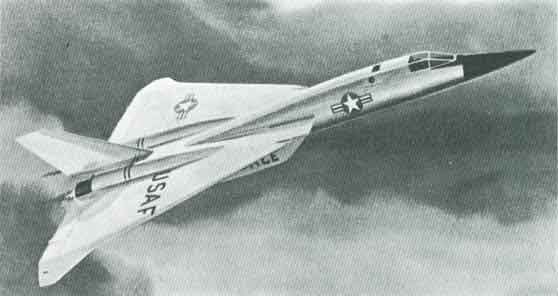
If one believes in infallible ‘fact sheets’ the F-108 according to one 'fact sheet', was to have two missions: Long Range Interceptor and Escort Fighter for the B-70. Evidence supporting the escort mission assertion is so thin, it is ’invisible’, while evidence supporting the Interceptor role is bountiful.

XF-108 Rapier: Never Reached Beyond Mock-up Stage
As I've noted to a commenter, I did not say or imply it (F-108) couldn’t or wouldn’t be an escort fighter if the need arose. I would assume it would do any ‘fighter’ mission it was assigned to varying degrees of success. I also asserted: There can be little doubt that there was someone, somewhere in the entire AF command structure who thought it would be a good ancillary/alternate mission for the F-108, but it was not part of the F-108 design requirements NOR was it part of F-108’s operational concept. I will say now that I would consider the ‘factsheet’ to be wrong in asserting an escort role (beyond possible for any fighter as a generic capability).

Most critically, given the nature of the operational concept envisioned for the F-108 and planned end strength, the use of the F-108 as an ‘escort fighter’ would probably be less likely than the F-106 it was designed to replace. This too is easily shown. And now it will be shown, thanks to my  serendipitous and very slight connection to the author of the following in his 1988 ACSC paper titled: The Search for an Advanced Fighter: a History From the XF-108 to the Advanced Tactical Fighter”.

Then Major (later Colonel) Robert Lyons wrote (beginning on Page 4):
The MX1554 "Ultimate Interceptor, 1954" produced the Convair F-102 that fell far short of the planned speed, altitude, and range performance (95:159-165). It could only fly at 677 Knots at 35,000 feet, with a maximum ceiling of 51,800 feet and 566 nautical mile combat radius (95:173). While the F-102 and its follow-on F-106 served as "interim interceptors," the Air Force developed requirements for a long range interceptor. These long range interceptor requirements, first developed in April 1953, were rewritten in July 1955 and November 1956, after several attempts failed to get an acceptable proposal from competing airframe contractors (114:Ch 2). The Air Force sought an interceptor to counter the perceived 1960 bomber threats of Mach 2.0 speed at 61,000 feet, and the revised 1963 bomber threats of Mach 2.2 to 2.7 speed at 65,000 feet (118:7,32; 114:Ch 2). Design studies to satisfy these requirements began in 1953 at Air Research and Development Command and in industry with the MX1554 designed to achieve a Mach 4.5, 150,000 pound Gross takeoff weight aircraft, but the aircraft appeared to lie beyond the state of the art (118:7,Fig 24). So another round of design studios attempted to meet the 1955 LRI (long range interceptor) requirements. These studies called for an aircraft with a cruise speed of Mach 1.7 at 60,000 feet and combat speed of Mach 2.5 at 63,000 feet, with a gross takeoff weight of 98,500 pound, But this aircraft would have had only marginal capability against the postulated 1963 bomber threat (118:7,Fig 24). 
A subsequent design competition in 1955 between Lockheed, Northrop, and North American was little better than previous ones, but North American came closest to meeting the goals, (114:23).
North American Aviation's letter contract of 6 June 1956 called for a long range interceptor that could operate at 70,000 feet with a combat speed of at least Mach 3. The all-weather interceptor aircraft was to have two engines, two crewmen, and at least two internally carried nuclear or conventional air-to-air missiles (95:330-331). Their Weapon System 202 configuration sported a single vertical tail and large delta wing, and was adopted in 1958 after considering iterations with as many as three vertical tails and a large canard (118:7, Fig 24; 95:331).
In 1960, toward the end of the heyday of the "Century Series" fighter aircraft, Weapon System 202, renamed the XF-108 Rapier interceptor, promised to serve the Air Force with a Mach 3 cruise speed and 1,000 nautical mile range as a companion to the proposed B-70 supersonic bomber (106:44). [SMSgt Mac Note: I believe the fact that the Rapier was based on common design concepts with the B-70, coming out of the same design stable and discussions concerning the parallels in performance parameters may be as much of a source of ‘escort’ fighter role stories for the F-108 as any other. ]  The XF-108 design evolved to meet all of the expected Soviet bomber threats of the early 1960s. It was to have been fabricated from stainless steel sheet, a welded sandwich and honeycomb, rather than aluminum to withstand the high temperatures and stresses of sustained supersonic flight. Its two General Electric J93-5 turbojet engines were to have used a special high energy synthetic fuel (ethyl borane) (7:14). It would also use the ASG-18 Fire control system, and the GAR-9 missile. All these were under development simultaneously with the basic airframe. This combination of features allowed a totally new concept of long range interception of the supersonic bombers believed to be under development by the Soviet Union. The F-108, with its superior radar and high speed missile, was to patrol the DEW (Distant Early Warning) Line and make SAGE (Strategic Air Ground Environment) directed, semi-autonomous interceptions well before incoming bombers could launch their weapons against the major cities of Canada or the United States (118:7-8,Fig 25-26,Fig28-30). 
But intelligence sources eventually proved a serious Soviet bomber threat did not exist. That news reinforced growing concerns in the Department of Defense (DoD) over the cost and viability of manned aircraft. Offensive and defensive missiles now seemed to be the logical technological choice for the 1960s (7:14; 8:7). In August 1959 the Air Force canceled the chemical fuel development program (7:14), and on 23 September canceled F-108 development (94:402; 8:7). The Air Force announced that the program had no technical difficulties and had met all goals it the time of cancellation, but that there was a shortage of funds and programming priorities had changed (57:63). Both the fire control system and the missile developments continued at a lower level of Funding. The cost estimate of five to eight billion dollars for a few squadrons of F-108s was more than could be accepted to replace the F-106, given the doubtful nature of the threat (7:14) and the unresolved fate of future manned aircraft.
With the cancellation of the F-108, there appeared temporarily to be a hiatus in supersonic interceptor work in the United States. Indeed, although the Air Force continued trying to gain support for new interceptors in general and the F-108 in particular, the DoD continued to oppose the requirement pending verification of a threat (9:3).
7. Air Force Times. 15 August 1959, p. 14.
8. Air Force Times. 3 October 1959, p. 7.
9. Air Force Times. 11 March 1964, p. 3. 57. "F-108 Cancelled." Canadian Avionics (November 1959), p.63.
94. Kennedy, William V. "Future of the Fighter." Ordnance (January-February 1970), pp. 402-406.
95. Knack, Marcelle Size. Encyclopedia of US Air Force Aircoraft and Missile Systems Volume1. Washington, D.C.: Office of Air Force History, 1978.
106. McCormacK, James, Jr., Maj Gen, USAF (Ret). "How the Air Force Is Buying Its Newest Manned Weapons." .Skyline (Fall 1958), pp. 44-47.
114. "NORAD's Quest for NIKE Zeus and a Long-Range Interceptor."(U). Ent AFB, CO: HQ NORAD/HO, 1962. SECRET-Declassified 31 December 1962. "Unclassified information only used from this source."
115. Neufeld, Jacob. "The F-15 Eagle: Origins and Development 1964-1972." (U). Pentagon, Washington, D.C.: HO USAF/HQ November 1974. SECRET "Unclassified information only used from this source." 
118. Parsons, T. R. "B-70 and F-108 Perspectives on Supersonic Cruise." .Proceedings of the Conference Ob the Operational Utility of Supersonic Cruise (U).Wright-Patterson AFB, OH: ASD/XR, May 1977. SECRET.-Declassified "Unclassified information only used from this source."
From the combination of the limited number of F-108 platforms, the operational concept of roving long-endurance patrols conducted at the farthest distances from home with limited and possibly nuclear payloads, as well as the intended purpose of replacing ‘interim’ interceptors, it is doubtful the F-108 would have had time for anything other than its interceptor role. If the Rapiers were to be ‘escort’ fighters at all, it would be in accompanying aircraft returning post-nuclear strike that might wander/enter their patrol areas, in a manner of what ANY fighter or other aircraft would do.


Updated 26 April 2012:


The  "Standard Aircraft Capabilities" of the F-108

Commenter BB1984 below reminded me of another public resource we can draw on in evaluating the accuracy of the Air Force’s F-108 ‘fact sheet’. Based upon review of the F-108’s Standard Aircraft Capability (SAC) sheets, from the earliest available at the resource (2 May 1958) to the last one available, 12 June 1959 (which was less than 6 months before the program was cancelled) we find two key points:

1. The F-108A mission was pure "long-range ‘interceptor". Anything else it could do would fall under ‘miscellaneous’ capabilities to be employed the same as for any GI’s job description: ‘other duties as required’.
From the 12 June 1959 F-108A SAC:
The primary mission of the F-108 weapon system is to deter armed attack against the U.S. and its area of defense responsibility by providing maximum defense potential against all airborne threats in the post-1962 time period. This defense function is implemented by the F-108’s potential to search out, evaluate, and destroy these hostiles at ranges beyond the capabilities of other defense systems. The F-108 is designed to operate not only in conjunction with SAGE and in cooperation with other weapons in the defense inventory, but to be equally effective well beyond the bounds of ground environment surveillance and under minimum operational control, relying on its self-contained high performance search, navigation, and communications equipment.

In time of war, F-108 operations can include directed intercepts and organized search missions resulting in repeated attacks with up to three kills by each interceptor. Operating beyond SAGE, the F-108 can make positive identification of DEW line violations, attack and trail hostile raids through remote areas, and report directly via long-range radio. Operating within the ZI, the F-108A performance features of all-weather capability, long range at Mach 3, and 15-minute turn-around, permit flexible commitment of forces to achieve the precise concentration of power required at any battle area with maximum retention of reserves.


The F-108A carries two crewmen and internally stowed missile armament. This high performance air vehicle cruises and combats at mach 3 with a 1000-nautical mile radius on internal fuel. It has a 1.2g maneuver ceiling in excess of 77,000 feet and a zoom-climb ceiling of 100,000 feet. Under normal loading and weather, the air vehicle requires runway lengths of only 3200 feet for take-of and landing. It can be operated from 6000-foot runways in all conditions of weather.  From a nominal 70,000 foot combat altitude , missile launch can be accomplished against any air-breathing target flying at altitudes from sea-level to 100,000 feet. The pulsed-doppler radar, with 40-inch antenna, provides target detection in excess of 100 nautical miles at all altitudes and is backed up by infrared search and track devices.


F-108A = Long Range Interceptor. First, Second, Last.
2. The weapons capability from beginning to end consisted of a payload of 3 GAR-9 missiles.  No Guns, No Bombs.No Rockets**

12 Jun 59 Standards Aircraft Capabilities Sheet, Weapons Sections
AF Museum and History Program's 'Factsheets': Swing and Miss
Unless someone threw ‘bombs’ on the F-108 in the last couple of months of the program trying to save it from the axe, The AF Museum and History Program has some ‘splainin’ to do. But even if it was an idea thrown out there in the death throes, if it didn’t get buy-in from the users, it didn’t count, in which case they still have some ‘splainin’ to do.
 **Definition of the term "rocket" in this timeframe was transititory. The GAR-9 indicated above stood for 'Guided Air Rocket'. The weapon would soon be renamed 'AIM-47' for 'Air Intercept Missile'-47. For real confusion look up the GAR-1 and it's short distinction as the 'F-98' before becoming the AIM-4. (the BOMARC was also known as the F-99 at the same time).

Thursday, April 19, 2012

Functional AR Project: IOC Achieved

The hunting optics arrived today, so the Varminter/Pig Sticker is fully operational.
Took a little less than 7 months to build. Most of the time spent either deciding what I wanted, or finding wanted parts available, or waiting for parts.  With the Magpul rail covers and three point set up this way, I like the way this setup works so I've decided to forgo the forward grip for now.

Since I've discovered that an AR is never 'finished', I'm taking the opportunity to declare it 'baselined' and achieved IOC status.


New scope: AIM 2.5-10x40 with red/green illuminated reticle and green laser. Surprisingly well made, especially for the price at Combat Optical.


The F-35 and the “Confused” Stephen Saideman

At first I thought Stephen Saideman’s blog post titled Lies, Damn Lies, and Gov't Statistics on his blog was merely more solid evidence that ‘Political Science’ involves little math and zero critical thought.
In the post, he linked to a CBC news web article titled “Competing cost estimates add to F-35 confusion”with this chart on it:
A Useless F-35 Cost Comparison,  Source: CBC News Website
There was, of course, some rather unsatisfying journalistic distortion in the text, and there was also this chart:
A Useless F-35 3-way Cost Comparison, Source: CBC News Website
He seems to now have doubled-down on the idea that Canadians were purposefully fed sunshine and butterflies on cost questions by writing an editorial for the Globe and Mail.

So to recap the story so far:
A ‘Political Scientist’ reads a rather dim news article (with some un-illuminating graphics claiming government ‘sourcing’ spicing up the page) pushing the idea that F-35 cost numbers being thrown about are ‘confusing’. He then blogs about same in a post titled “Lies, Damn Lies, and Gov’t Accounting”. Said Political Scientist then proceeds to write an editorial for the Globe and Mail titled “Unlike our allies, we glossed over the F-35's costs” .--And he did it all apparently based upon a rather limited awareness of the topic at hand.


Ahhh, Research!
Now, we can’t prove or disprove my earlier concerns as to demands for math and critical thinking in PolySci, but I do think we have justification to suspect a deficit of research skills and/or reading comprehension at the root of the Professor’s confusion. For you see, if the good Professor had bothered to go just one step (literally one click) further to attempt to disambiguate the numbers, he would have had a good start on gaining insight into that which befuddled him. (See red arrow on graphic to left) 


For IF the “Canada Research Chair in international security and ethnic conflict, Department of Political Science, McGill University” had bothered to click on a link provided at the first article he blogged about, he would have been taken to an official Canadian Defense forces website where he could view and download a more detailed breakdown of the high and low estimates floating around at the moment.
In the breakdown of costs at the link, he would have found such gems as the high ‘Parliamentary’ estimate for ‘Production’ costs has such problems as :
  1. Uses top down, parametric estimate
  2. Primarily based on historical costs of fighter aircraft per pound/kilogram
  3. Historical data not provided
  4. Does not factor economies of scale due to high annual production rate
  5. Assumes average unit cost of 2478 aircraft at $128.8M USD using their costing model
  6. Based on a learning curve model with only three data points including unsubstantiated average unit cost
  7. No evidence of model validation
  8. $1.5B error in the calculation of the learning curve which represents $200M in the calculation of the cost for sustainment
My favorite discrepancy between the two estimates has to be under the ‘Maintenance’ heading and I advise everyone to read it at the source.
Professor Saideman, who from what I can tell has been been a denizen of the Academic Ivory Tower (Social Scientists wing) his entire adult life, other than a stint at the Pentagon on essentially a one-year ‘career broadening’ tour as “Politico-Military Planner, Balkans Branch, Central and East Europe Division, Strategic Planning and Policy Directorate". Given his limited practical experience, it is unsurprising that he would find complex program defense acquisition and sustainment cost estimates confusing. Sadly it is also equally unsurprising that lack of consequential knowledge Aerospace or Defense Acquisition does not seem to provide him any inhibitions in giving in to impulses to proffer commentary on same to the general public.
Update: The professor has now posted another bit related to comments he’s received over at the Globe and Mail. Sounds like he’s getting heat from all quarters for his little ‘drive-by’. He has a nice little hand-waving at the end of it:
Anyhow, I am pleased that folks are interested in the topic and in my views on it, but I also realize that the folks commenting already have strong beliefs and see in my op-ed what they want to see. Not the first nor last we will be encountering our frenemy known as confirmation bias
Heh. “Confirmation bias”?

‘Project’ much?

Note: I did not even bother to deal with Professor Saideman's factual errors, such as claims that Japan has cut their F-35 order, because such errors are trivial in light of what is noted above. (Blogger paste errors corrected 4/19 in the AM.)

Tuesday, April 17, 2012

The B-52 Turns 60: What IF? (Part 3)

(To Start at Part 1: 1946-47 Click Here)

Introduction:

It has been written that “What If?” is historian’s “favorite secret question”. Would the B-52 have become the venerable icon of airpower that it is ‘then’, if American communications and norms had been different?

What if’ 1946-1952 was anything like 2006-2012?

(All persons and institutions are fictional, Any resemblance of characters cited within to persons living or dead is pure serendipity ).

1950

XB-52 (Model 464-67), Source: Boeing
In November 1949, convinced that the inadequate range of the Model 464-49 could seriously jeopardize the future of the entire project, Boeing undertook an effort to improve the range. As an answer, Boeing offered a heaver version known as the Model 464-67. The wing remained the same, but the length of the fuselage was increased to 152 feet 8 inches, offering more space for fuel. Gross weight was estimated at 390,000 pounds. Combat radius was estimated at 3500 miles. The Model 464-67 was looked upon favorably by SAC personnel, including General LeMay. On January 26, 1950, a conference was held at USAF Headquarters to consider once again the future of the B-52. Alternatives were considered once again, including new proposals from Douglas and Republic, Fairchild Aircraft Corporation's idea for a rail-launched flying wing, the swept-wing Convair YB-60, a Rand turboprop aircraft, two new designs based on the B-47, plus several missile aircraft. Although the meeting adjourned without reaching any firm decision, General LeMay still backed the B-52 as providing the best solution for SAC's strategic mission. In February 1950 the Air Staff requested performance and cost data for all the strategic vehicles so far proposed. In the same month, however, General LeMay asked the Board of Senior Officers to accept the Boeing 464-67 in lieu of the Model 464-49. This choice was approved by the Board on March 24, 1950, but there was still no definitive commitment to production. --Origins of the B-52

--Peacenik Objectors Gone Overboard (POGO) 1950 Press Release
Air Force Leadership Suppresses Competition At Taxpayer’s Expense
The Air Force, in a move indicative of the utter contempt for the American taxpayers has killed the possibility of holding any meaningful competition to fulfill the requirement for a new heavy bomber. With the problems found with the new newly fielded B-50 and B-36, the Air Force should be exerting its energies in fixing existing problems rather than seeking to field even more advanced technology. The Air Force is now openly speaking of the new B-50s and B-36s as ‘interim’ designs whose hundreds of millions or perhaps billions of dollars in development costs will now have been wasted fielding aircraft that will only fly for a few short years if the Air Force has its way. Congress should act now to force the military to clean up their existing messes before they are allowed to proceed with production of their newest unneeded weapon.
‘Wheels’ Wincelow: Centre of Defense Disinformation (CDI) Press Release
The Bomber Forces ‘Death Spiral’
The Air Force now plans to retire their entire fleets of B-50s and B-36s with new bloated bomber program. It is alleged that General Lemay has stated he fears the costs of the new bomber could prevent acquisition of more than 100 aircraft. This new, overly complex and overly ambitious bomber design bought in such small quantities cannot match the capabilities of the more than 700 B-50s and B-36s now delivered or planned could provide.
Phil Sweetham (Aviation Leaks)
The design of the Air Force’s new bomber, now identified as the XB-52 is STILL changing. If this plane is ever fielded (doubtful), expect it to be many years from now and in even smaller quantities than the 100 currently feared as unit costs will undoubtedly continue to skyrocket.
1951

Final Design Evolution to Production Configuration
On January 9, 1951, USAF Chief of Staff General Hoyt S. Vandenberg approved a proposal that the B-52 be acquired as a replacement for the B-36. Letter Contract AF33(038)-21096, signed on February 14, 1951, was the first contract authorizing production. It called for an initial batch of 13 B-52As (with serials 52-001/013), with first delivery slated for April of 1953. Still more controversy broke out among the USAF hierarchy as to whether the B-52 would be better employed as a bomber or a reconnaissance aircraft. SAC wanted a dual-role aircraft which could accommodate a pod-mounted set of reconnaissance sensors that were easily remov[e]able so that the aircraft could quickly be reconfigured as a straightforward bomber. USAF Headquarters wanted the B-52 to concentrate on the reconnaissance role with the exclusion of everything else. In October of 1951, the Air Staff issued an order that all aircraft would be RB-52 reconnaissance aircraft. This directive was actually misleading, since it was agreed that the aircraft would retain the ability to be converted for bombardment operations. Early in 1951, General LeMay told Boeing that he thought that the tandem seating arrangement featured by the XB-52 mockup was poor. General LeMay believed that side-by-side seating of pilot and copilot was superior, since it allowed more room for flight instrumentation and permitted the co-pilot to be a better assistant to the pilot. In August 1951, it was decided that the Air Force would adopt the side-by-side arrangement, but that some of the early production B-52s would still retain the tandem seating arrangement. This was later amended to stipulate that only the two prototypes would retain the tandem seating arrangement, with all production machines having side-by side seating for pilot and co-pilot. --Origins of the B-52

Derek Palmetto – Letters to the Editor, Sydney Daily Herald

Well, the Americans have decided to waste hundreds of millions of US Dollars not only fielding an unnecessary bomber, but the first batch aren’t even representative of the production standard, and later versions will be incorporating fixes to shortcomings already known to exist, These ‘mistake jets’ will have to be fixed later, or more likely retired early further adding to the magnitude of wasted taxpayer dollars. The early retirement of the B-36, which it has been announced that the B-52 will be replacing, means many of the dollars and much of the effort to produce the Peacemakers have been wasted as well.

Phil Sweetham (Aviation Leaks)

The Air Force has much explaining to do as to why their nearly-new bomber fleet already needs replacement, if claims justifying the B-52 are REAL that is. We note that the Air Force has changed their tune as to the B-52’s purpose. Is its mission ‘reconnaissance’ or ‘strategic bombing’? What else will the Air Force claim its new plaything can do, if Congress doesn’t bite on their rationale this time around?


‘Wheels’ Wincelow: Centre of Defense Disinformation (CDI) Press Release
"Overkill: Too Many Nukes" Congress should trim the Air Force’s plans to acquire potentially several hundred B-52 Bombers. With the B-52’s massive payload and the ever-shrinking packaging of Atomic weapons, surely we will reach the practical upper limit of weaponry required to act as a deterrence and fielding more than the required number will only make other nations suspect us of ulterior motives. Please forget that ‘Death Spiral’ thing I mentioned earlier. I’ll let you know when we’re really serious about using it again.
“Oh, the Controversy!”--Title of Stranger Room column, Dave Axiom, ‘Mired’ magazine

1952


1. The XB-52 and YB-52 take to the skies,
2. Some B-52A orders are converted to B-52Bs,
3. Critics yammer on….