Commentary and discussion on world events from the perspective that all goings-on can be related to one of the six elements of National Power: Military, Economic, Cultural, Demographic, Organizational, & Geographical. All Elements are interrelated and rarely can one be discussed without also discussing its impact on the others
- Full Block 3F mission systems development and testing cannot be completed by May 2017, the date reflected in the most recent Program Office schedule, which is seven months later than the date planned after the 2012 restructure of the program. Although the program has recently acknowledged some schedule pressure and began referencing July 31, 2017, as the end of SDD flight test, that date is unrealistic as well. Instead, the program will likely not finish Block 3F development and flight testing prior to January 2018,...
• Insufficient time and resources to conduct all required weapons delivery accuracy (WDA) events. The program completed a surge of weapons test events in August and is analyzing the results. While some of the events appear to have been successful, several WDAs unsurprisingly had significant issues that either required control room intervention or the employment of the weapon was likely unsuccessful. Despite making some progress, the program still has not completed the full set of planned test events for Block 3F weapons in the TEMP, with 13 WDAs remaining, excluding the multiple gun scoring events, which must also be completed. Due to the limited time and funding remaining in SDD, the program has prioritized completing testing of new and deficient Block 3F mission systems capabilities over completing the remaining WDAs. While completion of Block 3F mission systems is necessary, the WDAs are also an integral part of successfully completing required development and adequate testing of full Block 3F capabilities. Each of the planned WDA events is an essential end-to-end test of the full fire-control chain. Conducting all of the WDAs is the only way to discover problems that otherwise will be realized in operational test and/or combat. For example, one of the recent AIM-120 missile WDA events required control room intervention to direct the pilot when to launch, as there were no shoot cues or launch zone indications displayed to the pilot due to an outdated AIM-120 missile attack model within the mission systems software. Due to their importance and the distinct differences among them, all of the planned WDA events must be completed during DT; otherwise, these events will have to be completed before or during IOT &E, which will delay discovery of deficiencies and the completion of IOT&E while adding to its cost.
“This was kind of a cleanup, or a closeout, of (System Development and Demonstration). It’s the closeout of JSF developmental test for Block 3F, which is a big deal because it’s for Air Force IOC, and Navy IOC,” he said….
…“I like to think of these as the last for Developmental Test,” he said. “This is like our graduation exercise before we hand the aircraft off to the operational test organizations so they can go prove it’s ready for combat. That’s very significant for us.”…
…There is a single WDA event remaining for 3F, which marks the completion for all three variants and will pave the way to the declaration of IOC for all F-35s.
Now, If you are a journalist and EVER cited DOT&E as if they knew WTF they were talking about, then take a large mallet and apply it forcefully to your forehead in penance. Ye shall be known by thy flat face.
What's the lesson here? There is a reason this quote was displayed in the entryway to ASD HQ at Wright Patterson back in the 80s-Early 90s.
How Would You "Score" Maneuverability Requirements Today? Part 1
Since maneuverability is a hot topic these days (especially here)....
As I noted in a post ages ago, in the 1980's Skow, Hamilton and Taylor (Ref 1) observed:
“In the late 1940's and early 1950’s, with the advent of jet propulsion, radical new wing designs and greatly expanded flight envelopes, a corresponding need for more definitive measures of merit for aircraft performance comparisons was generated. When the "century series" fighters were developed and rear-aspect IR missiles became the principal air-to-air combat weapon, point performance comparisons were found to be inconclusive and insufficient to predict superiority. Out of this need, energy-maneuverability (E-M) concepts were formulated and developed. In the 1960's. E-M came into widespread use by aircraft designers and fighter pilots. E-M provided an analog picture of a fighter's performance capabilities over a range of velocities and altitudes. It gave quantifiable credit to measures of merit which allowed the advantages of speed (energy) and turning (maneuverability) to be balanced. These measures of merit were shown to be dominant in determining the outcome of an air battle at that time.
...
But, as they say, time marches on, and in the past 10-12 years, several significant advancements have been made in the capabilities of fighter aircraft and air-to-air weapons. Three of these advancements; the all-aspect IR missile, greatly improved weapons delivery systems, and high thrust-to-weight engines have dramatically altered the character of the air battle, especially the close-in fight. The modern air battle is characterized by (1) time compression – shorter duration maneuvering required and (2) harder maneuvering - nose position at the expense of energy vs. nose position with energy conservation…
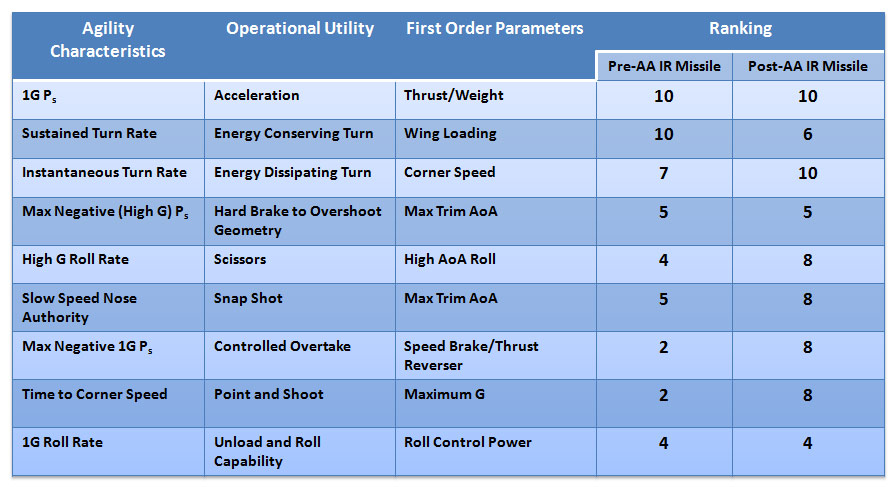
Air combat trends have expanded to ever increasing altitudes and speeds for beyond visual range (BVR) combat and conversely have tended to a lower and sometimes slower arena for close-in, within visual range (WVR) combat. … …This changing complexion of air combat, primarily due to the all-aspect IR missile, has altered the relative significance of the various performance characteristics with which we judge relative merit. Table 3 depicts the more common agility characteristics with some relative rankings.”
Time does march on, and so fighter and threat technology have progressed since 1985. So....
What About Today?
Regular readers will recognize this table from that earlier post:
'Table 3' Reconstruction from “Advanced Fighter Agility Metrics”
The authors of the original table and paper recognized the game changing aspects of being able to engage with missiles from 'all aspects' and those changes in their view re-jiggered the fighter maneuverability design priorities.
As I see it, this would be a two part mental exercise. First we need to add columns on the right side of the table identifying any 'game-changing' developments that would cause further changes to the rankings shown. Stealth is an obvious development, but are there others like "very-high off-boresight missiles".
Before I put too much grey matter onto the project, I thought I'd open the floor for ideas, and then decide (collectively if there is interest) first what order and perhaps grouping the header(s) should be populated from left to right. I THINK the columns should be added in order of chronological developments, but I don't KNOW yet: I try to keep an open mind until info is in hand.
The end product of Phase 1/Question 1 would be the jumping off point for exploration of how these developments may change the relative rank ordering. I think I'm going to solicit inputs from F-16.net board members in a thread of its own, but I would welcome an even wider range of inputs and insights.
Survey Question 1: What has changed since 1985 that would affect the rank ordering scores that each 'Agility Characteristic' (as the term is used in the table) would receive?
Reference:
ADVANCED FIGHTER AGILITY METRICS; Andrew M. Skow, William L. Hamilton, John H. Taylor; AIAA-A85-47027
Why Any Inference that the F-35 2015 'Post-Stall Agility' Control Law (CLAW) Test As a 'Dogfight' is Bogus
This is a rework of something I posted on twice in 2015. I'm doing the rework a a form of blog 'housekeeping'. When I wrote about it in 2015, the focus was on the echo-chamber, click-bait media claiming or inferring the CLAW test was a 'Dogfight' test. When I look back at that post, I now feel I buried the lede twice. The important bits were not how media tends to be F.O.S. for all their shenanigans (that's hardly 'news'), but the reasons WHY it was not a 'Dogfight' test, and that it can be clearly shown it was NOT a 'dogfight' test are.
Nowadays that the 2015 'controversy' seems to be a perennial word-count filler: something for the lazy media to put in a piece to 'balance out' any positive information about the F-35 in any article or story that might appear to be otherwise 'favoring' the F-35. I want to be very specific in what I am claiming going forward.
Assertion: The event in question was a post-stall agility test, testing for areas where it might be worthwhile to 'open up' the control laws (CLAWs) and was not a 'dogfight'.
The 2015 Testing in Question was Described in 2014
Supporting Evidence:
The JSFPO and Lockheed Martin at the time of this faux controversy asserted it was a CLAW test. The assertion was met with much snark and derision from the professional cynics and F-35 Haters, yet that is exactly what the test was about. and it was described in a published technical paper by an LM engineer who should certainly know WTF the test was going to be about at the time he wrote the paper.
From the 2014 AIAA paper "F-35A High Angle-of-Attack Testing"[1], by Mr. Steve Baer, (Lockheed Martin "Aeronautical Engineer, Flying Qualities" at Edwards AFB), and presented to the Atmospheric Flight Mechanics Conference held 16-20 June 2014, in Atlanta, Georgia we find that F-35 High AoA testing was designed to follow in the following progression:
"The test objectives for high angle-of-attack testing are as follows:
1) Characterize the flyqualities [sic] at AoAs from 20° to the control law limit regime with operationally representative maneuvers.
2) Demonstrate the aircraft’s ability to recover from out of control flight and assess deep stall susceptibility
3) Evaluate the effectiveness and usefulness of the automatic pitch rocker (APR)
4) Evaluate departure resistance at both positive and negative AoA with center of gravity (CG) positions up to the aft limit and with maximum lateral asymmetry.
5) Assess the handling qualities of the aircraft in the High AoA flight."
Let's observe here that from the paper itself we can tell it was written while Objective #4 testing was ongoing and published at about the time it concluded. This observation is supported by the paper's passage [emphasis/brackets mine]:
With intentional departure testing [Objective #4] wrapped up, the team will soon move into departure resistance [Still Objective #4] and plan to remove the SRC now that these systems have been verified. In this phase of testing, the jet will test the CLAW limiters with much higher energy and rates than previous testing, fleshing out and correcting areas that may be departure prone. Lastly, select operational maneuvers [Objective #5], such as a slow down turn and a Split-S, will be used to gather handling qualities data on high AoA maneuvers. With the completion of this phase, the F-35 will be released for initial operational capability in the high AoA region.
Note: 'SRC' is a 'Spin Recovery Chute'.
Clearly the testing was not yet at step #5 at the time of writing but to emphasize same, the author followed the above paragraph with [brackets/emphasis mine]:
While the flight test team will explore legacy high AoA maneuvers for handling qualities, it will be the Operational Test and Evaluation team that will truly develop high AoA maneuvers for the F-35. In the operational world, a pilot should rarely be taking the F-35 into the high angle-of-attack regime, but the ability to do so could make the difference between being the victor or the victim in air-to-air combat....
So with this paragraph, not only does the author expound on the exploring of "legacy high AoA maneuvers" that is to come, he specifically identifies Objective 5 test as having "Handling Qualities" objectives and explicitly states that the kind of testing that will "truly develop high AoA maneuvers for the F-35" to the testing Operational Testers will perform later and excluded from the Edwards AFB Developmental Test Team activities.
In a nutshell, just within these two paragraphs that Baer wrote in early/mid 2014 is precisely what the JPO/LM stated in their official response to claims that the 2015 event involved some kind of 'dogfight'.
Therefore the "reasonable man" may logically and confidently conclude the LM/JSFPO response:
1. WAS NOT simply something that was contrived in response to stories built around leaked program documents but...
2. WAS accurately asserting the truth about what the testing purpose truly was.
Now here we are two years later...
By next year and the roll out of '3F' software/capabilities I doubt if you will be able to find an F-16 pilot who has flown the F-35 that would not pick the F-35 over the F-16. [1] AIAA #2014-2057
With the world about to bear witness at the Paris Air Show (#PAS17) this week that the F-35 is NOT the 'pig' aircraft that the propagandist critics (all of whom have NO material knowledge of the F-35) have claimed, I decided it was time to finally publish this post and close out the series. All the contrived elaborate and ignorant ‘stories’ assembled from twisted factoids that have surfaced over the years, are about to fall flat, and will trigger much denial, wailing and gnashing of teeth from those quarters.
Now is also an especially good time for me to close out the series because it will be a handy reference for later smacking down a piece of anti-JSF Dezinformatsia that surfaced (as a metaphorical rotting dead cetacean) this week.
Behold! O haters and doubters.....and weep.
Super-manueverability without Thrust Vectoring, Check...
And so we proceed…
The entire point of this series has been and is to illustrate that fighter design isn’t driven by opinions, whim, or fashion; nor is the implementation of it either the least bit capricious.
To recap, Part 1 of this series was just an initial outline of what I intended to cover/accomplish overall. Part 2 was an extended ‘two-parts in one’ review of the evolution of fighter design requirements from the earliest days and up through the emergence of ‘supermaneuverability’. We reviewed the developments that influenced fighter designs up through to the ‘fourth-generation’ of fighters and we could even say included design trends that influenced the earliest aerodynamics of fifth generation design: the F-22.
This brings us up to the starting point for Part 3, still somewhat in the past, but not so far as to prevent us from getting to the present from there.
In the introduction of this series, I had originally envisioned that in Part 3 we would:
..."break down a 1 vs. 1 air combat scenario into a high-level conceptual model of constituent phases and associated combatant states. Then we will apprise the F-35’s potential advantages and disadvantages”...
As it turns out, we can leverage one and a half decades of expertise from professionals to accomplish the first objective and do so in fewer words than I had initially planned. We will also use the same for framing the discussion to meet the second objective: quickly ‘apprising’ the “F-35’s potential advantages and disadvantages”. It should shock only those with less than a passing interest in, and/or superficial knowledge of the subject, that by the time the first Part 3 objective is met, the second objective will become largely self-evident.
Before the X-31 even flew, it was already viewed as a key investigative tool for ‘applied agility’ research, and the only effort at the time to span all “applied” research areas of interest.
Figure 1. X-31 Spanned Applied Agility Research Interests
I was TDY to Edwards AFB for one program or another and we had just landed (it had to have been sometime in 1992 or January-ish 1993 at the latest) and while sitting on the ramp waiting for a crew van, we watched the X-31 return from a mission and work the pattern with its chase plane. The discussion, led by our own test pilots and flight test engineers, turned to wondering: Just how much any additional maneuverability that might come out of the X-31 program would actually translate into any REAL additional combat capability? This is a question of the same kind of ‘asymptotic limits’ that were addressed in Part 2.
As it turns out, we still can’t quantify an answer to that question because nothing about that time on up through to the present day was, or is, “static”. Changes and developments in all the other fighter aircraft capabilities and technologies kept evolving long after we hit peak ‘supermaneuverability’ with the X-31. But from Part 2 and what we are about to review, we can answer the question in general:
1) Maneuverability beyond the F-16/F-18 characteristics doesn’t really get you all that much more capability (effectiveness and survivability), and
2) When costs involved are considered, there are cheaper/better ways to increase combat offensive capability and survivability than improving AoA, turn rates, or g-loads past the present state of the art.
We know these are the answers because those involved in fighter design and development have known them for a long time. From 1986 through at least 1995, the NATO member countries of France, Germany, the United Kingdom, and the United States collaborated on a major study1 to determine where future fighter design efforts should be targeted.
Note:
While I’ve been too busy to engage in substantial posting for a lot of reasons, another reason this post was so long in coming is the open source data has been fickle. I first typed out about 4K words (longer than this post) I had put to electrons just to go over the gory details in the study we are about to discuss. But after all that work trying to do justice to the contents of the study I found a copy of the original without a paywall in place. I slashed what I had written to leverage the source without saving the earlier version. Then the source disappeared again. If access reappears, I'll link to it.
The study had two major objectives:
• Through analysis and simulation, determine whether supermaneuverability is operationally useful in future air combat scenarios.
• If operationally useful and technically feasible, determine the practical limits of supermaneuverability and full envelope agility.
The context of the study was obviously about the benefits of supermaneuverability in WVR combat. The authors referred to it as “Close In Combat” (CIC), of which choosing to engage in a turning fight is only one possibility. After all there’s not much point in doing a Danse Macabre if there’s no opponent within visual range to ‘appreciate’ it.
The study participants used the following definitions:
“Supermaneuverability is defined as very high levels of maneuverability and agility throughout the flight envelope of a fighter aircraft, especially beyond maximum lift.”
“Agility is defined as the ability to change states rapidly with precision.”
“Full envelope agility contains airframe, missile, and avionics attributes.”
It is important to observe here the recognition by the actual “experts” involved that the broadest definition of agility was important going in to the study. The definition of 'weapon system agility' has become a somewhat standard one:
Previous analyses and manned simulations for close-in-combat (CIC), primarily emphasizing 1 v. 1, have indicated substantial improvements in air combat effectiveness when supermaneuverability (in particular, post-stall technology) was incorporated in advanced fighter designs. Recognizing that air combat scenarios are likely characterized by rapid transition from beyond-visual-range (BVR) to CIC involving multiple aircraft, the effect of supermaneuverability technologies on the outcome of this type of engagement needs to be determined.
This multi-national NATO-sponsored study began with manned simulation at Industrieanlagen-Betriebsgesellschaft (iABG), involving two piloted aircraft and three computer generated aircraft. Four pilots were trained on the baseline post-stall aircraft including avionics, weapons, and scenarios. After the training phase, the pilots jointly determined possible starting conditions (geometry, speed, weight, weapons load, number of runs, etc.).
The purpose of the manned simulation was to create a database to develop a digital pilot reaction model. The application of a batch model was necessary in order to generate the large number of computer runs needed to accomplish the project goals. The batch simulation strategy involved three different programs. First, the ‘Arena’ war simulation program was used to model a beyond-visual-range, many-on-many air battle and generate within-visual-range starting conditions. This was a valuable technique that got the study group past the ‘How do we set up realistic WVR combat starting points?’ question. Second, the Air-to-Air System Performance Evaluation Model (AASPEM) was used to model one-versus-one (1 v 1) engagements that were initialized under the Arena-derived starting conditions. Third, the Abductory Induction Mechanism (AIM™) was used to link AASPEM results to Arena as depicted in Fig. 3.
Figure 3. Source: Practical Limits of Supermaneuverability and Full Envelope Agility
As you can see by the parsing of function among different models, it wasn’t easy to do complex scenario modeling back in the 80’s-90’s. The primary models had to be linked because neither one could answer the questions ask if used as standalone devices. An evolved MIL-ASSPEM II was part of the USAF’s standard analysis toolkit as late as 2005. It might still be.
The study identified and used probability of kill, probability of survival, and exchange ratio as “the key parameters” using two types of weapons: missiles and guns. For each weapon type they assigned a probability of a kill (Pk) given a ‘hit’. Under a ‘massive-number-of-trials’ modeling effort, they established an average Pk of a (AIM-9L ‘like’) missile of 0.8 for each simulated missile fly-out. The Pk (given a ‘hit’) of the missiles being held constant may have made some of the long-term study quantifiable results more conservative ‘offensively’ and more optimistic ‘defensively’ than optimum, given the lethality enhancements seen with AIM-9 and AIM-120 developments ongoing at the time and later. The advantage of using a constant Missile Pkvalue is that it prevents missile lethality from dominating the calculations and masking nuances in outcomes due to other variations in the aircraft/missile (as a system) combinations. ‘Pk’ for the gun was more complex, and was based upon a function of the maximum burst length for one firing and the time duration of the gun hits within that burst.
The baseline “good-guys” (Blue aircraft) were assumed to have the ‘agility’ of the X-31, and the baseline “bad-guys” (Red aircraft) represented an “F-18 type aircraft”. Given the study timeframe we can probably assume the “F-18 type” aircraft comparisons were based upon the F-18C/D versions.
The study group ran multiple excursions of the 'sort-of-a-metamodel' they created, exploring the relative impacts of increasing aircraft and weapons capabilities on the outcomes of air combat engagements. A recreation of the contents in the matrix of different test cases explored and as summarized in the study’s Table 8 is shown in Figure 4.
Figure 4. Cases studied in "Practical Limits of Supermaneuverability and Full Envelope Agility"
The engagements were run under set conditions to control the number of variables. The following are the rules of engagement used for 1 v. 1 engagements:
• 120 second duration
• No kill removals
• Each aircraft started with same fuel load
• Each aircraft had 4 missiles and a gun
• Conditions for gun firing:
- Minimum range = 500 ft
- Maximum range = 3500 ft
- Tracking delay = 0.2 seconds
- Pipper size = 3.5 MIL (±2°)
All of these criteria were controls based upon expert analysis and historical records except the “No Kill Removals”. The ability to count wins and losses in a test run without ‘kills’ that would remove the killed aircraft from the equation allowed for many more engagements (trials) to add up within each computer simulation run. This approach in modeling was akin to the process of re-spawning adversary aircraft in Red Flag or similar exercises, though with a somewhat different purpose. Today, we would run more trials with actual removals because computer time is cheaper and the runs are faster.
What was learned
Figure 5. The Bottom Line of Modern WVR Combat
In trying all the various combinations of possible enhancements (and degradations) the authors produced many relevant ‘findings’ associated with each of the design changes and combinations thereof.
1. Aircraft Agility Changes: Blue’s losses were serious, but Red Losses were even worse.
Blue losses were seen as high (around 45%) for the baseline case; aircraft agility increased the red losses by 20%, while blue losses increased slightly.
2. Enhanced Missile Capability: Blue’s losses were still serious, but Red Losses were even more severe.
Blue losses were high (around 45%). However, red losses increased drastically to near 70% against the most capable missile option.
3. Enhanced Avionics: Just improving avionics didn’t help Blue’s effectiveness or survivability.
Overall, there was virtually no effect on exchange ratio or losses (which, once again, were around 45%) for the Blue Force.
4. Combined Short-Range Missile (SRM) and Avionics Enhancements.
Blue losses are again high (40-45%). Red losses were slightly lower than that for the same missile using baseline avionics, but still significant approaching 70%.
5. Aircraft Agility with SRM Enhancements.
Losses remained high (up to 52% for blue and up to 66% for red).
6. Aircraft Agility with Avionics Enhancements.
Red losses were again higher than blue losses (20% higher), but both remained high (above 45%).
7. Combined Enhancements.
Again, blue losses were high (48% for the "best" system). Red losses increased to beyond 70%.
The biggest benefit of EFM that could be drawn from the study was that EFM pays off significantly IF the A2A fight STARTS very ‘close in’ under 1 v. 1 situations AND inside the minimum range (Rmin) of the ‘then-era’ of Short Range Missiles with limited OBC (Off-Boresight Capability up to 30°), AND IF no further aircraft enter the combat (remains a 1 vs 1 engagement). Within the study, EFM largely enhanced gun firing opportunities that come well after the initial ‘long-game’ has been played and those outcomes settled. That advantage is now questionable with SRMs that have very high OBS capability. No one has to actually point anywhere near the opponent in WVR combat anymore to be able to take offensive action against that opponent.
And for the readers who just skimmed the WVR engagement outcomes above and didn't see Figure 5, let us now explicitly state that the WVR ‘short game’ IF it comes at all, during the course of this study was determined to be an unsustainable “loser’s game” between comparable opponents. This has now been known for decades, and findings such as these had to have influenced the definition of the F-35’s requirements.
Given that 1) ‘modern’ low observability predates this study significantly-- at least in the U.S.—and 2) low observability makes a foe far more lethal to 4th generation and earlier aircraft as well as more dangerous surface to air systems, it should speak volumes to any reasonable person as to why the design thrust of the F-22 and F-35 (and now others) emphasizes the reduction of susceptibility to being targeted in the first place, while (as in the case of the F-35) also emphasizes the ability to sense, discern, and assist the pilot in dealing with external threats as effectively and efficiently as possible.
We can be certain that the responsible agencies involved conducted manifold similar studies involving the effects and limits of low observability in combination with all other design drivers to produce the latest fighter designs. I can’t imagine what kind of thinking is required by the uninvolved to imagine the professionals make these kinds of analyses and force structure decisions without due diligence.
How many more pilots, planes, and support assets would ‘blue’ forces need to win a war of attrition if only WVR-capable “day fighters” and/or non-‘stealth’ aircraft are involved? This is an important question. After all, simple ‘less capable’ fighters are what all those earnest and/or Faux Reform critics advocate to varying degree when they are insisting the actual experts are doing fighter acquisition “wrong”. Advocates of less capable systems are advocates for a strategy of Wars of Attrition.
The frequency--how often WVR conditions would occur between aircraft (again, they were all non-LO aircraft) -- was to be a subject of the Arena runs of the future. I’ve not found the results of this effort in unclassified sources, but given what we’ve learned from all air combat that has occurred since that time, and experiences in major exercises such as in recent Red Flags, I would suspect WVR encounters, and certainly 'extended turning' fights, will become even more of a rarity.
Given the improved min-range performance of short-range missiles and future non-kinetic weapon solutions on the horizon, extended maneuvering fights might become extinct. At the very least, they could become ‘black-swan’ encounters not worthy of driving aircraft design in the future nearly as much as in the past, that is, at least for the foreseeable future.
How potential enemies see the future is indicated in how hard they work to either follow the US lead in design trends or in attempting to devise ways to mitigate the advantages sought by the U.S. and its allies. “Advantages” such as those that come from the capabilities of the Fifth Generation fighters.
The entirety of EFM-AASPEM work performed during the study was devoted to within-visual-range 1 v. 1 combat. Comparisons were made based on firing opportunities, exchange ratio, and losses. One really needs to read the study to understand the nuances of the findings, but by way of introduction to the findings, let us observe what key conclusions were drawn. [ My comments in brackets]:
• The most significant contribution to operational effectiveness was increased OBC coupled with enhanced avionics (mainly due to helmet mounted displays). Further improvements were possible when Rmin [Minimum Range] was reduced. [Missile Rmins have been getting smaller, and off boresight capabilities have expanded wildly beyond any assumptions in the study since the report was published. The utility of an advanced HMD has been recognized as far back as the earliest F-15 requirements list. It’s good to see technology has finally advanced enough for the concept to have come of age in the F-35.]
• Missile and avionics enhancements have to be harmonized to fully make use of the improvement potential. It should be noted that missile/avionics OBC enhancements will provide even higher impacts in the many-on-many environment. [And the F-35’s integrated avionics/sensor fusion are now the epitome of this idea made real.]
• Aircraft agility contributes to a certain extent, although not as significantly as missile/avionics enhancements. To make full use of agility, new aircraft designs might be required concerning aircraft kinematics and aerodynamics. [‘Agility’ as defined by the research pointed to just the kind of design philosophy used for the F-35.]
• Conventional aircraft performance enhancements do not improve system effectiveness. If envisaged, they would also require new aircraft designs. [Asymptotic limits of maneuverability have been reached. Perhaps it is a plateau for the current technology available, but I would suspect there will have to be a breakthrough no one has yet identified as needing to happen first.]
• Degraded aircraft performance [Aero efficiency and Thrust to Weight for the most part] can hardly be compensated by enhanced agility. The degradation decreases the conventional turn capability which is a "defensive" potential. A decrease of this potential enables the opponent to generate increased firing opportunities. [In a WVR world fighters will still need to be able to turn and burn. Think of it as the lower limit of maneuverability isn’t going away just because the practical upper limit has been reached.]
• Degraded aircraft performance might be compensated by suitable missile/avionics enhancements. Although the same degradation concerning "defensive" potential applies, more firing opportunities can be generated earlier. [This is actually not a new thought. If Glenn Bugos’ history of the F-4 is to be believed (and I believe most of it is quite on target), much of the F-4 Phantom design was philosophical: driven by how best to divide the ‘capability’ between the missiles carried and the aircraft carrying missiles and to a lesser extent fleet radar support.]
Some of the last findings in the study report can be said to have become even MORE true since it was written [Brackets still mine]:
During the last 10-12 years, [and now two decades since the study report] there has been significant improvement in missile technology. Next generation missiles [ASRAAM, AIM-9X, etc.] have better seekers and more sophisticated fly-out capabilities to make successful use of better thrust vector control, thereby improving missile agility in the close-in environment as well as endgame performance. [The missile performance realized in today’s generation of missiles exceed that ever envisioned in the study]. In addition, [aircraft] avionics have improved to make use of high OBC. [And of what the study authors would have considered impossibly-high OBC.]
These developments [through and past 1995 and that were and are ongoing] make the new generation SRM/avionics attractive; however, the high mutual loss rates [expected to increase further] with all type of enhancements will "stress" the recommendation to urgently improve situational awareness as well as beyond-visual-range effectiveness to avoid WVR/CIC. [And unsurprisingly has been incorporated into the F-35 design.]
“Fighter Aircraft” Design as Always is STILL Driven by Operational Requirements
(Bumped)
Operational requirements have evolved continuously since the first fighters flew. It would be as large a folly to insist that a fleet of 4th generation fighters could meet the needs of current and foreseeable operational requirements as to insist a WWI aircraft could meet the requirements of a WWII operational environment.
Compare what we know now about ‘where’ air-to-air combat is going with the kinds of capabilities built into fighters like the F-35 and F-22, and what potential ‘near-peers’ are trying to build. Given the study findings, 5th generation fighter capabilities, and actual air combat history, WVR combat is now something to be even avoided more; something any A2A combatant would seek to avoid if at all possible and only to be endured if unavoidable.
Defense planning and foresight informed by experience and research, such as that embodied in the study we just reviewed, produces the requirements for future weapon systems that resulted in the F-35. I marvel at how much hybris the uninformed must possess to shamelessly assert alternate realities while second guessing legions of actual subject matter experts who have done the work day-in and day-out for decades to deliver viable solutions to defense requirements, and who have access to the kind of data and history needed to actually carry out such responsibilities.
The future of fighter design and design requirements will change as the operational environment changes. This is why as soon as one ‘generation’ of fighters is being fielded, work begins to define what will be needed in the next generation. Work on what became the F-15 began as soon as the AF got the F-4. The F-22 is descended from the first efforts to define what would be needed after the F-15 as the first F-15s were in development. Yes, we can envision some of these future changes (lasers anyone?) and can imagine how strategists and designers will cope with them. But the entire battlespace will continue to be reshaped beyond any analyst’s imagination and prevent them from peering too far into the future just as it always has been.
NOTE:
Nowhere in this series of posts, or in any other posts the reader will find here, is the assertion made that ‘maneuverability’ (however one defines it) is "unimportant"-- in the past, modern day or immediate future. This must be stated unambiguously up front because I've seen the tiresome broad-brush accusation of same made too often when anyone dares challenge some closely held belief as to maneuverability’s relative importance to fighter design, or dares challenge the vague reasons why many of the uninitiated think “maneuverability” is important.
A Request in Closing: If history repeats itself, when this post is referenced on a ‘board’ or comment thread somewhere, some yahoo is probably going to contest what I have written as “SMSgt Mac is wrong…”. As if their disagreement is with ‘me’-- when they’re really expressing their disagreement with…y’know…the ACTUAL experts I cited. I usually trip over these weak statements. while looking for something else, ages (sometimes years) after the mischaracterization of what I typed is displayed: long after the disinformation damage is done and everyone has since moved on to other topics. Soooo…If one finds this happening somewhere after this post, it would be much appreciated if a reader or two would reply in response that “SMSgt Mac said you would try that B.S. deflection”. Feel free to use the direct quote.
1. Practical Limits of Supermaneuverability and Full Envelope Agility; B.A. Kish, D.R. Mittlestead, G. Wunderlich, J.M. Tokar, T. Hooper, R. Hare, H. Duchatelle, P. Le Blaye; Proceedings from the AIAA Flight Simulation Technologies Conference, San Diego, CA, July 29-31, 1996; PP 177-187; AIAA Paper 96-3493.
The only thing worse than 'phoning it in'.... is doing so with incredibly poor timing.
28 April 2017
“For me, it’s my first time dogfighting against an F-15”….“Dogfighting is a test of pilot skill, but it’s also constrained by the aircraft’s capabilities and I’ve been really impressed by the flight control and maneuverability of the F-35.”
There was a poor article published at Business Insider (as if that is a surprise) on 18 April where the author did a mashup of an interview of a retired USMC Major and F-35 pilot with a bunch of factoids, a few facts, and...well, let's just call it a lot of 'other than facts', such as repeating the lie about the 2015 CLAW test being a 'dogfight' and claims like.
The F-35A's mid-mission T/W ratio is better than 1 to 1, good enough to have pilots saying that at typical WVR speeds it can out accelerate an F-16. The F-35A's wing reference area is greater than an F-16 so one presumes he was talking about 'wing loading' -- which isn't a big deal if you've got the thrust to overcome it. I would still dearly love it if some enterprising journalist ever asked how many thousand pounds heavier the early production F-35A (AF-2) with instrumentation is than the first production spec weight target aircraft that was built several LRIPs later. Because weight matters.
What the pilot, Dan Flatley had to say was pretty good and consistent with all the other feedback from the people who fly the F-35 are saying. I think it should have been made clear that his views as a syllabus developer were in no way relevant to the JSF program process and pace in opening up the control laws (the very purpose of that 2015 exercise and publically known a year in advance), but the BI author seems to tie the two together more than the pilot does.
Everyone in the test program knew the control laws start out conservative for safety's sake and over time as the envelope is tested, the control laws get loosened to get all the 'safe' performance out of a jet that possible. I'd also want some clarifications, but that need comes from the author's mashup. One has to read very carefully to keep from mixing up what the author asserts and the correlations he draws on his own with the interview: what was actually quoted as coming from the Major. The author doesn't have the technical chops to draw the correlations he does make (see thrust/weight ratio), and to me, unless you already knew what was going on, the article just muddies the waters.
Poor Writing Causes Even Poorer Writing
So as if that's not bad enough, we now have a sterling example of how perverted 'copypasta' will take a poorly written article and turn it into a misquoted source. Compare the BI excerpt with an excerpt from a blogger posting opinions on the subject. Who the blogger is isn't important, what's important is what gets changed in the original story.
Now here's the copypasta:
Ignoring the highlights in the second graphic, do you see what was changed and how the entire meaning of the passage was changed with it?
.
.
.
(intermission)
.
.
.
In the original, Major Flatley states: "If you try to fly it like the fighter it isn't, you're going to have terrible results."
In the copypasta, the blogger quotes Flately as stating: "If you try to fly it like the fighter, it isn't. You're going to have terrible results."
I hope there's no need to explain how, why, and what meaning has been lost in the translation there.
The blogger then builds a whole rant based on a misquote he made in the transcription. I do not believe this was intentional, at least I hope it wasn't. BI doesn't allow simple copy/paste using at least some browsers, including mine, so the transcription was probably manual and prone to human error. But I have to believe preconceived notions caused the mistranslation from one site to the next. Why?
To make that kind of error, it seems you would have to want it to be as you perceived it to even want to post about it in the first place.
Too good to check
The saddest thing is, I checked the comments (69 at the time) and not one person called the blogger out on the error. Almost certainly for most it was because the error reaffirmed their own world view, and the rest seemed to just take it at face value that the quote was legit and correct, whether they agreed or disagreed. This is how B.S. thrives on the web.
Note: I found the blog post with a search engine while looking for the BI article. It was at a site I used to frequent and my curiosity was piqued. Considering the time of night, I shouldn't have bothered in retrospect.
President Trump set wheels in motion that have turned the long-standing 'F-35 is unaffordable' deception inside out. The whole world now knows the F-35 unit costs are coming down exactly as planned and for -- as any honest person who's been paying attention already knows -- the same reasons the program has been citing all along.
How did Pres. Trump spread the word/change the narrative so quickly?
He leveraged the mainstream media's 'narrative priorities' and the lockstep and unthinking pursuit of narrative to suit their priorities.
Kneejerk Media PWNED
Thanks to the media's rabid dislike/disapproval of President Trump and ANY of his actions,
2. And when the media latched, again in lockstep, onto the "costs were already coming down" story, LM's CEO casually mentions 'but' the President DID help, if only by sharpening the negotiations' focus on 'Costs'.
Over the past five to six years, the F-35 program “has performed pretty close to the [budget] estimates,”
My take
President Trump's involvement/interest has helped topple an information blackout and for now a Faux Military Reform Industry meme. I'm reminded of the old quote:
A man may do an immense deal of good, if he does not care who gets the credit for it.
I don't care what people think about 'why' the unit costs are coming down as planned. I'm happy just knowing that people know they ARE coming down. Driving the media crazy over it is just a Trump side-benefit.
(1) XXXXXXXX has revised the XXXXXXXX flight test program by decreasing the data collection requirements that were originally planned;
(2) program documents state that, although flight testing is behind schedule, program decisions to reduce test points will enable the XXXXXXXX to regain lost time and complete development testing in XXXXXXXX, as originally planned;
(3) XXXXXXXX program documents identified numerous deficiencies relative to the aircraft's operational performance;
(4) the most challenging technical issue is XXXXXXXX;
(5) until these issues are resolved through software or hardware changes that have been adequately tested, the cost, schedule, and operational performance impact of resolving these deficiencies cannot be determined;
(6) the XXXXXXXX remains confident that it can correct these deficiencies;
(7) in addition, XXXXXXXX that assesses risk areas in the XXXXXXXX program stated in XXXXXXXX, that operational testing may determine that the aircraft is not operationally effective or suitable;
(8) a XXXXXXXX preliminary operational assessment report, which is classified and based on limited data and analysis, identified 16 major deficiencies with the XXXXXXXX aircraft but concluded that the XXXXXXXX is potentially operationally effective and suitable;
(9) the XXXXXXXX has consistently stated that the XXXXXXXX will be developed and produced within the cost estimates established for the program;
(10) certain key assumptions on which the cost estimate was made have been overtaken by events;
(11) program documents state that the current development effort is funded based on the assumption that problems would not occur during testing;
(12) unanticipated aircraft deficiencies have occurred, and most of the program's management reserve has been depleted;
(13) since the flight test program has about 1 year remaining, it is probable that additional deficiencies will develop;
(14) correcting current and potential future deficiencies could result in the development effort exceeding the congressional cost cap;
(15) the XXXXXXXX unit procurement cost estimates are understated;
(16) these cost estimates were based on what has become unrealistically high quantities of XXXXXXXX aircraft that will be bought; and
(17) more realistic assumptions indicate that, although the total procurement cost will decrease, the XXXXXXXX unit cost will be more than the XXXXXXXX currently estimates.
It does gives proof to the old adage "If it bleeds it leads' but my, how 'Southeast Asia 1965' of them.
What's more important: Were the right terrorists killed. This is pretty much a repeat of what I posted at F-16.net
Q: Why use B-2s? A: So ISIS never saw us coming.
Q: Why 2 B-2s to drop 38 weapons when 1 can carry 80 500lb JDAMs?
A: To bomb both locations at the same time, like probably down to the last second unless they wanted to cause a response in one first by bombing the other. And more than 38-40 would have probably been overkill.
Q:
Was this cost-effective? A: Aside from killing the terrorists who would have carried out attacks in Europe and probably elsewhere now and later (CNN and their 'militants'....F*! both.) it probably:
a. flattened their training facilities, weapons building capability and stockpile and the trainers of future terrorists,
b. it will also make the survivors look up in the sky at night and loose their beauty sleep.
The immediate and later costs of letting any attacks happen probably far outweighed the cost of flying 2 B-2s and expending a few bombs.
There are some less obvious positives about this, given the 'international' interest in the region, but I will not air them here.
Now expect some slacker in the media to use the 'kitchen sink' definition of $/FH to rail against the strike as 'wasteful' in 5...4...3...2...
On a personal note...
I had a very small role in fielding the Smart Bomb Rack Assembly (Smart BRA: gotta' love it). I suppose since they dropped only 38 JDAMs they could have used the Rotary Launchers (RLAs) but that's OK too, since I also played a small role developing and testing the smart weapons interface that allowed GATS/GAM then JDAMs etc. to be dropped as well.
I feel pretty good about all that right now.
Updated 20 Jan 17:Well now the reports coming in say 'over 100' JDAMs, and some specifically assert 110 JDAMs were dropped in two camps. It appears by some accounts there were to be up to four camps targeted initially but the terrorists had consolidated as well as relocated between the time the missions were conceived and executed. I'm sure the AF still enjoys it when targets bunch up.
It would have been hard to move assets around the Middle East to hit Libya like this without contrarian interests leaking it beforehand, I still remember Operation Allied Force and how ops departures out of Comiso seemed to be on TV in real time. The message here is: you won't see us coming unless we want you to.
Breaking Defense has an advocacy piece up at Breaking Defense titled: "Trump Wants Lower F-35 Costs, He Should Compete F135 Engine"from Retired USAF Colonel John Venable (who is now with the Heritage Center). In it, Venable tries to make a case for reviving a second engine effort for the F-35. But in typical AF 'advocacy style guide' fashion, elides right by many key factors to consider while throwing all possible arguments at the wall trying to make one stick. I wanted to just make a comment at BD, but since they've invoked the ads among the commenters in their comment threads their web page tends to crash on me for all but the shortest comments. Could be the times, could be my system (Adobe updater is always a suspect). In any case, here are my observations on the sales pitch Venable makes. Read the whole BD article first to see the targets of my counterpoints.
RE: Competition
‘Competition!’ is almost always a good thing in an open commercial and ‘free’ market, the kind of market most of us deal with every day. However, it is only a good idea sometimes, under certain conditions, in a monopsonistic (such as ‘defense’) market. At the risk of oversimplifying almost as much as the author, in a defense market a competition is generally ‘good’ for reducing risk and improving technical outcomes, but generally NOT good for reducing ‘cost’.
The body of defense acquisition research is awash with the whys and wherefores of when and how a program should invoke competition. Though people like to point to the Great Engine War history in this instance, they tend to forget that most of that ‘narrative’ was written before the history had fully played out.Later views on the utility and relevance of that competition to the F-35 are far more nuanced than simple invocation of the Great Engine War can convey.
Not to put too fine a point on it, there are certain requirements for a successful (cost lowering) competition (see herefor starters) and one of the most important set of conditions has to do with the total volume of work competed AND the rate to which it is to be performed. Two operations running at reduced capacity are NOT cheaper than one running at full capacity. So if the author and Heritage want to advocate competition in this case, they need to caveat that advocacy with a requirement to ramp up the F-35 production rates sufficiently and far enough ahead of any doubling of the number of engine suppliers to ensure sufficient and worthwhile demand for same.
Finally, given the program is looking to refresh F-35 engine technology, you better have the second engine supplier qualified and production ramped up yesterday if you don’t want it competing with the effort that now appears to be on the F-35's horizon (mid 2020s). How much so-called 'savings' can possibly accrue if there's only a couple of years production involved?
RE: F-35 Weight
Is the author aware that the F-35 variants are all at or below their target weights for the end of SDD? Is he aware that those target weights were set with an allowance for further weight growth already factored in? Is the author aware that weight growth in past aircraft (both the F-16 and F-18 spring immediately to mind) was driven primarily by scabbing kinds of needed systems (sensors, EW, etc.) onto them that are already integral to the F-35 design and already installed or have their weight already accounted for in the target weights?
RE: Thrust
Is the author aware that increased thrust has been available from the F135 for some time if is needed, but increased thrust will require changes/differences in the F-35B along with associated program cost increases to incorporate?
While we’re on the subject of cost, no doubt the author also has a plan to add a couple of $B to the program in order to finish development of a second engine, to include getting everyone on board with the idea AND happy about the extra cost involved including the cheapskatesbudget conscious and the faux military reform industry.
RE: 'Transonic Acceleration' and 'Sustained G' KPPs
Is the author aware that the transonic acceleration and sustained turn KPPS are only factors in the trade space below Lethality and Survivability requirements, and that their values are only relevant as contributors to the overall requirements? If the program is not concerned, the author ought to first find out 'why' before engaging in public handwringing. I've examined these KPPs before (here and here) so I get why the program isn't too concerned. As the KPP values were established with a mid-mission weight and payload involved, and assuming some degraded engine performance towards end of life, perhaps some of the author's concerns will be allayed knowing that similarly equipped F-16s in most cases couldn't do any better?
Table 3 Reconstruction from “Advanced Fighter Agility Metrics” Andrew M. Skow, Willlam L. Hamilton, John H. Taylor; AIAA-A85-47027 10 = most important
We won’t go into it here, but even these measures of agility may have been rendered less important with higher off-boresight and 'shorter minimum' range missiles (that's probably going to come in the next part or part after of my fighter design series by the way--still working on it).
In any case, advocating more thrust to improve these metrics is pretty hapless if one thinks about the speed regions involved. It's probably more important that the F-35 variants are meeting/beating their weight targets.
So all the arguments for adding the second engine into the F-35, at least for the factors above, seem to be rather unconvincing. As to the decision to stop the GE engine effort, which was very immature, it made sense. How immature? As I observed in 2014:
In the spring of 2010, the F136 was only 700 hours into a 10,000 hour test program and had not been flight tested. No one knows what problems it would have encountered had it been fully developed. But in its cancellation, the F136 has become the mythical 'success-that-could-have-been-but-never-was' to the proverbial ‘some’ in the backbenches.
Let's keep the F136 the mythical success it is, at least as far as the F-35 is concerned.
This is just too funny and too easy to debunk for me to pass up. I just gotta point out the stupid involved. Kyle Mizokami tripped over a thread in Reddit and built a nice 'on the one hand, but on the other hand'F-35 "narrative" for Popular Mechanics that is so lame it answers the question as to why most media writers aren't paid as much as they think they're worth. It is a shame too, because with really very little research, and demonstration of a minimal understanding of economics--specifically the 'time value' of money and proper use of deflators -- he could have contributed significantly to killing the false narrative that the F-35 program is 'plagued by (fill in the blank)'. Instead, he tries, and fails to make the F-35 look bad, using numbers that when applied correctly only make the point that the F-35 program, and the problems that have been encountered are in no way unique.
Here's the PM story:
A New York Times newspaper article describes a beleaguered American fighter program enduring delays, escalating costs, and technical problems. Another article about the F-35 Joint Strike Fighter no doubt, right? Nope. It's an article from 1977 about the F-16 Fighting Falcon.
The F-16 was the original multinational fighter. Developed by the United States with Belgium, Denmark, the Netherlands, and Norway as partners, the fighter was designed to be an agile, lightweight, daytime fighter to replace aging fighters such as the F-5 Freedom Fighter and the F-104 Starfighter. At $6,091,000 per unit—$27.1 million when adjusted for inflation—it was also supposed to be inexpensive.
Many of the F-16's past problems are mirror images of the issues we see in the F-35. According to the article, the Air Force expected the F-16's research and development costs rose by some $7 billion to reach $13.8 billion by 1986. Adjusted for inflation, that's $54.7 billion in today's dollars. F-35 R&D costs, on the other hand, are estimated at $107 billion dollars to date.
Like the F-35, the F-16's problems arose from technological issues and design challenges. The fly-by-wire mechanism of the F-16, in which an aerodynamically unstable but highly maneuverable aircraft was tamed by computers to keep it flying, was an expensive problem that was eventually solved. Like the F-35, the F-16 had problems with its engine and also had to be modified to placate U.S. allies who wanted a fighter capable of air-to-ground missions, a real multi-role fighter.
Still, as similar as the problems between these two planes are, the F-35's problems are much more intense. The F-35 was originally slated to cost $50 million apiece—nearly twice the original cost of the F-16 at today's prices—but the three versions of the plane currently run anywhere from $112 to $120 million each. The F-16 encountered months of delays, but the F-35 A/B/C models will, on average, be delayed half a decade.
Yes, America and her allies have been down this road before, but this time it is a lot rockier.
First, the 'costs' narrative whereby Mizokami attempts to make it look like the F-35 is MUCH worse than it's predecessor....when it is not that different at all.
RE: The F-16's “$6,091,000 per unit—$27.1 million when adjusted for inflation”.
I don’t know where he got the $27.1M inflation unit cost value (though given the depth of research he shows I suspect he just found a number) but it strongly correlates with Contemporary Opportunity Costs between 1976-77 and 2015.
In terms of a project’s Economy Cost (relative share of the GDP used: the correct figure for 'projects') that 1977 F-16 unit cost would equal $58.2 million in 2015 dollars. [Note: Calculators I used for the interested are here.]
RE:
“the Air Force expected the F-16's research and development costs rose by some $7 billion to reach $13.8 billion by 1986. Adjusted for inflation, that's $54.7 billion in today's dollars. F-35 R&D costs, on the other hand, are estimated at $107 billion dollars to date”
This is an odd disconnect from Mizokami's unit cost claim and the R&D figure he used for the F-16 DOES equal about $54B in 2015 Economy Cost, so who knows why the author came up with a lower number for the unit cost of the 1977 F-16 in “today’s dollars”.
It was widely touted early in the F-35 program that we could develop three aircraft for the cost of 1.5 to 2 aircraft. Craptastic! RAND policy pieces non-withstanding, let's note that the estimated F-35 R&D costs that Mizokami uses (and we will watch these estimates as they become 'real') are running about 2 times that of the 1977-era's F-16 R&D costs when adjusted for inflation. That seems pretty reasonable, considering the F-16 is the cheapest of the 'Big three' aircraft designs (F-16, F-18C/D, AV-8B) whose capabilities drove the requirements for the F-35 design.
Even the F-16 as we know it today involves much more content and cost as Mizokami indirectly acknowledges than that of the 1977 F-16, so how about we consider all the additional ‘content’ the F-16 now has that it didn’t have in 1976-77? What was the later ‘development cost added’ that came with the later ‘value added’? We can't compare apples and apples directly, but we can get an idea about unit costs at least . In 2012, it was said that the F-16V would be less than half the “then” cost (Richard Aboulafia) of the F-35. Anyone remember the 2012 F-35 unit cost? It was $125-150M a copy depending upon who’s chart you’re looking at in whatever FY$’s being discussed. (see charts lifted from F-16.net's voluminous archives to the left)
That would make the F-16V somewhere in the $60M-70M range in 2012 dollars. Guess what that is in 2015 dollars? Go ahead do the calculations).
That's right. the F-16V would probably cost $70M-$80M (Economy Cost) in 2015 dollars. Note that also does not include the same 'content' that comes on an F-35.
People who rail about F-35 costs fall into one or more of three camps:
1. The willfully ignorant or gullible who’ll fall for anything.
2. The liars who have their own agendas
3. The internet's village idiots.
Enough about dollars. How about some history instead of Mizokami's stories?
RE: "Like the F-35, the F-16 had problems with its engine and also had to be modified to placate U.S. allies who wanted a fighter capable of air-to-ground missions, a real multi-role fighter."
1. The AF ALWAYS wanted the bells and whistles that were finally delivered with the first Block 30 F-16s. It wasn't the 'allies'. Don't believe me? Just look at what then recently retired Gen John Vogt who had commanded USAFE was saying about what was needed while the F-16 was in early development via a Euro 'Hit piece' from the period:
This rather poor documentary looks even sillier now than it did at the time, given the successes of the F-16 (airplane and program) that came soon thereafter. But it's value in illustrating how the stripped down version of the F-16, the day-time knife-fighter that the faux reformers wanted, was a politically driven, and not operational requirements-driven configuration endures. Of course, we could also simply review the history of the development to see the USAF always wanted more on board the F-16. This was made possible only by advancements in small electronics technology that then had to be developed for military aerospace. And TANSTAAFL.
RE: "The F-16 encountered months of delays, but the F-35 A/B/C models will, on average, be delayed half a decade."
'Delays' are a measure of the difference between 'time planned' and 'time scheduled' to reach some meaningful achievement. If you want to compare the F-16 development with the F-35's, then the baseline F-35 Block 3 will be achieved two years faster (with about 1600 fewer aircraft produced) than the F-16's Baseline Block 30. The biggest difference between the F-16 and F-35 programs is the differences in size of the initial 'brass ring' being sought.
Finally, a minor nit to pick about the F-16 so-called 'engine problems'. If Misokami cared to do some research, he'd find that the problems never really affected the F-16 like the F-15, partially because of the installation, and partially because the F-15 was the lead user o the PW F100.
Misokami's story could have been a good one. In any case, if Mizokami read a little more widely, he would have known about this part of F-16 development 'history' over NINE Years ago.