Showing posts with label Aerospace. Show all posts

Sunday, March 18, 2018

Again With the Space Force? aka: Dorky-Pants Solution Revisited

A shout out to all the politicos who've given enough thought about a particular unfortunate set of circumstances but not a fraction more than passing thought as to the dorky-pants solutions they are trying to float to make things better: A "Space Force" or "Space Corps".

Now contrary to what anyone just tuning in on the subject might think, the idea of a Space Force or Space Corps didn't spring up in President Trump's brain spontaneously, you now have to wade through pages of MSM click-bait articles in Google on "Trump" to find where starting last year, the idea for a 'Space Force' or more specifically a 'Space Corps' was being pushed in public by Alabama Congressman Mike Rogers.

Why a separate Space Force, or Semi-separate Space Corps is a Dorky-Pants Solution.  

Problem: The problem we have in Space is the same problem we've always had: too many agencies with too many cooks stirring the pot. The problem, like most with DoD, is born on Congressional failure: Congress has failed to consolidate authority with the service responsible training and equipping forces for space in general (the USAF), instead Congress has chosen to preserve individual service interests in the service infrastructures and then lament the parochial attitudes.

Whereas simply moving authority and resources to the service responsible for oversight of space interests, where it should already be (that's right, the Air Force) is the proper move, the Dorky-Pants solution would create ANOTHER new entity entirely and move (more likely unsuccessfully) all of the Space authority and responsibility from the existing services into that brand new entity. If the headquarters for that new service somehow elevated the prospects for Redstone Army Arsenal, the Army's missile mecca and Alabama's largest employer, I'm sure we could put that down to serendipity.

To summarize:
Congressional Dorky-Pants Solution: create more institutional overhead and consolidate authority and responsibility in one place    
Common Sense Solution: Consolidate authority where Congress already put the responsibility. This is easily determined by which service gets to spend the most time in front of bloviators explaining why something isn't like they want it to be. Hint: this would be the Air Force.  
So this is not really a new post, but I wanted to keep the 2006 original where it was instead of bumping it and just add more introductory materiel that will tie it to current events. The 2006 version has held up quite well I think, and if time permitted I would expand it with more detail and historical references. But I don't. So here is the original :

**************************
Feb 2006...

Every now and then I want to unload with a more substantial topic than the 'Outrage of the Day'. So here goes...

Separate Space Force? Someday
A lot of 'futurists out there want a Space Force now.
and yeah, I've been thinking about this for a while.....

Introduction

The discussion surrounding a possible separate military service responsible for "Space" has been heating up for years. Critics of the current system that has the Army, Air Force and Navy participating as components of a joint Strategic Command (an arrangement that has existed since 2002) feel the current system, like the system before it where individual service components reported to a unified U.S. Space Command, does not offer real advocacy for "Space".

The usual criticism is that the system merely perpetuates the relative apportionment of the "space pie". Whether or not the criticism is valid is not germane to the question of a need for a separate space service. What must be done is to use the principles and rationales that were behind the creation of the existing services, and overlay them on the current question of a separate space force. Using this methodology it will become obvious that there is no valid reason for creating a separate Space Force at this time.

Core Problem

The main difficulty in addressing the problem is that the individual service branches and the parent Department of Defense (DoD), as institutions, do not fully understand the reasons for the continued division in their responsibilities. They fail to understand the reasons because they do not recognize them. This failure comes about largely because the two most senior of the three independent services, the Army and the Navy have their conceptual roots in ancient history, and so the issue has not been thoroughly examined, or even greatly reflected upon, for centuries. It is also due to the fact that the third service, the Air Force, is still so new that some still believe it should be part of the other two services, and that the Air Force's own self-perception as an institution is still evolving(1).

Service self-perceptions have been further muddied in light of the Goldwater-Nichols (2) Act which, among other changes, made the nine unified combatant commands' Commanders (formerly called CINCs) directly responsible to the President through the Secretary of Defense. These Commanders are America's "warlords", who command organizations that have "broad, continuing missions" and are "composed of forces from two or more military departments (3).” Thus, the chain of command above the actual combatant commands now circumvents individual service chains of command and cultures. The individual services are no longer directly connected to, much less responsible for, the conduct of war.

Dilettantes and partisans assert that we have unnecessary overlap in the Roles and Missions of the different Services. Some have so grossly oversimplified the Service structures as to assert the US has ‘four air forces’ (4) or ‘two armies’(5). Setting aside resolving this issue for a moment, let us examine the specifics of the individual Service’s approach to the exploitation of the Space milieu.

Service Views on the Stewardship of Space

There was not even an American Air Force when the first military use of space occurred: the Nazi's V-2 rocket entered space on its sub-orbital hops from mainland Europe to England. At the end of the war, the Army and Navy vigorously pursued their own space programs using captured German technology as a seed for their own programs. The Army and Navy orbited the first and second United States military satellites respectively. The Air Force, as a new service in its own right, began immediately investigating military uses of space.

The Army and Navy saw (and still see) space as critical to performing their mission, and all services acknowledge that the Space dimension of warfare is going to grow even more important. This relevance to all the services drives their concern for space.

The Army and Navy stake some claim related to their role on land and sea, but only the Air Force has laid definitive doctrinal claim to space as a service-specific area of responsibility. All see space as part of a "continuum"(6) in which they operate, but the Navy and Army see it as part of a continuum of different environments through which they project force. Only the Air Force views space not as an extension into a different environment but as part of a continuous environment that is one of air AND space:

“Our Service views the flight domain of air and space as a seamless operational medium. The environmental differences between air and space do not separate employment of aerospace power within them.”(7).

It is this concept of the medium, central to the Air Force view, which caused Air Force General Larry D. White to coin the term “aerospace,” in 1954, and also later led to the Air Force being assigned the land based leg of the strategic "Triad"; ICBMs.

So all the Services find “Space” a critical element to their mission. When will Space warrant it’s own separate Service?

Looking Back To The Origins of the Existing Services

As mentioned earlier, the key to justifying the origin of a separate Space Force is found in the origins of the existing services.

The concept of an "Army" precedes recorded history, or at the very least has existed since history began. An army's purpose was (and is) to advance or defend some social construct. Since warfare only occurred on land, ancient armies were responsible for the total defense needs of a society.

In ancient times, a state’s ‘navy’ was the sum total of all it’s sea-going fleet of merchant ships. Around 1200 BC, the first recorded sea battle occurred between the Egyptians and the Sea People. This first battle was between sea-borne infantry forces carried aboard small ships designed for other purposes. If the nature of man has not changed too much over the centuries, there can be little doubt this battle on the ocean set off the first calls for an independent combat Navy: But for centuries that followed, the Navy's sole combat purpose was to transport the Army to far shores for use in land battles. While occasionally sea combat occurred, it was always in context of supporting land-based objectives, by ramming the enemy and using foot soldiers engaged in close combat. Eventually, technologies were developed for sea-based combat, such as purpose built ships with catapults (the first naval artillery). Over time the growing importance of sea-borne trade to a society's survival also created a need to protect that trade. The focus then shifted to exploiting the sea medium as a means to directly support societal objectives, not exploiting the sea medium to support land-oriented combat. In short, control of the sea became an important objective in its own right.

Roles and Missions Vs. Mediums and Methods

Modern discussions of the different services have focused on how their Roles and Missions are unique yet mutually supportive. But ‘Roles and Missions’ are the ‘what’ in how Service responsibilities differ and are merely products of the differences in ‘Mediums and Methods’.

The ‘Mediums and Methods’ are the ‘why’ we have different Services.

For centuries now, the purpose of the Army has been to exploit terrain and the Navy's has been to exploit the sea to support societal (now national) objectives. When man first began to fly, a new medium for conflict and exercising National Power became available. It’s an environment distinctly different from the others, in that it is a three-dimensional and global medium. Like the earliest naval combat example, it was originally viewed in the context of its usefulness to the other mediums, but over time has become important in its own right (non-withstanding the fact that there are those who would see the Air element as forever a supporting element.)

The other services still use the air (now aerospace) as an environment in exploiting their primary mediums, as the Air Force also uses the land and sea in exploiting aerospace. The key to understanding the delineation among the services is to understand that while they all use the land, sea, and aerospace mediums, each one is only responsible for development of methods to exploit one of the mediums. Thus, instead of thinking of the services in terms of Roles and Missions, it is more appropriate to think of the delineation in terms of Mediums and Methods.

The Goldwater-Nichols Act has driven home this concept, by completing the separation of the individual services from the direct responsibility to conduct warfare operations and explicitly tasking the individual services for providing the right forces, through training, research and development, and acquisition, to exploit their respective mediums under a joint service effort.

Air and Space or Aerospace?

So at what point does Aerospace yield to "Space"? As stated earlier, the key to justifying the origin of a separate Space Force is found in the origins of the existing services. Each service is chartered to exploit a medium for national defense. The need for each service to become a separate entity came about when its medium and operation within that medium became important in its own right to a societal interest. At this time, all space operations (8) are important as a support element to or sub-part of operations in the other mediums, and clearly within the concept of Aerospace. As the 'space' portion of Aerospace becomes a more critical part of what would previously be considered pure "air" operations, it would probably be appropriate for the Air Force to become the Aerospace Force.

Conclusion

Space will become an important medium in its own right when stand-alone activity in space becomes important to national interests. When space becomes an important medium in its own right, separate from its support function to operations in other mediums, space will warrant a separate service charter to exploit and develop the medium of Space sans "Aero." This will likely occur after we are living and working permanently in deep space, executing non-earth-centric operations and then only after we are out there with a more significant investment in resources and personnel. Examples of this kind of environment includes permanent self-sustaining space-borne activities, such as Lunar or Lagrangian-based large scale manufacturing concerns, that cannot be effectively protected or developed by Aerospace forces. Eventually, as extra-terrestrial colonization is established, a Space Force will be necessary to ensure free trade and movement among far-flung interests.

References:
(1) See The Masks of War and The Icarus Syndrome by the late Carl Builder for excellent analyses and summaries of the service branchs' self-perception.
(2) See Goldwater-Nichols Act of 1986 at http://www.ndu.edu/library/pubs/gol-nich.html for a complete summary.
(3) Ibid
(4) Senator Sam Nunn on the Senate Floor, 1992. http://www.cdi.org/adm/617/
(5) Richard D. Hooker, America’s 2 Armies, http://www.dtic.mil/doctrine/jel/jfq_pubs/jfq0806.pdf
(6) An excellent example of this is found in Space is an Ocean, a briefing on the Naval Strategic Vision for Space by the Strategy and Policy Division (N51), Office of the Chief of Naval Operations, retrieved 1 March 2002 from http://www.hq.navy.mil/n3n5/Topsight/space/spaceTP3/tsld001.htm
(7)United States Air Force, The Aerospace Force (Washington D.C., 2000), i. See also, United States Air
Force, America’s Air Force Vision 2020: Global Vigilance, Reach, and Power, (Washington D.C., 2000), page 3.
(8) See The Transformation of American Air Power by Benjamin S. Lambeth. “A functional or operational, as opposed to a systems, approach to thinking about space power application should make the differences between orbital and atmospheric operations irrelevant.” Page 258 (Cornell University Press, 2000)

Thursday, June 29, 2017

A Survey: What does State of the Art Fighter Maneuverability Look Like?


How Would You "Score" Maneuverability Requirements Today? Part 1

Since maneuverability is a hot topic these days (especially here)....


As I noted in a post ages ago, in the 1980's Skow, Hamilton and Taylor (Ref 1) observed:
“In the late 1940's and early 1950’s, with the advent of jet propulsion, radical new wing designs and greatly expanded flight envelopes, a corresponding need for more definitive measures of merit for aircraft performance comparisons was generated. When the "century series" fighters were developed and rear-aspect IR missiles became the principal air-to-air combat weapon, point performance comparisons were found to be inconclusive and insufficient to predict superiority. Out of this need, energy-maneuverability (E-M) concepts were formulated and developed. In the 1960's. E-M came into widespread use by aircraft designers and fighter pilots. E-M provided an analog picture of a fighter's performance capabilities over a range of velocities and altitudes. It gave quantifiable credit to measures of merit which allowed the advantages of speed (energy) and turning (maneuverability) to be balanced. These measures of merit were shown to be dominant in determining the outcome of an air battle at that time.  
 ...
But, as they say, time marches on, and in the past 10-12 years, several significant advancements have been made in the capabilities of fighter aircraft and air-to-air weapons. Three of these advancements; the all-aspect IR missile, greatly improved weapons delivery systems, and high thrust-to-weight engines have dramatically altered the character of the air battle, especially the close-in fight. The modern air battle is characterized by (1) time compression – shorter duration maneuvering required and (2) harder maneuvering - nose position at the expense of energy vs. nose position with energy conservation…
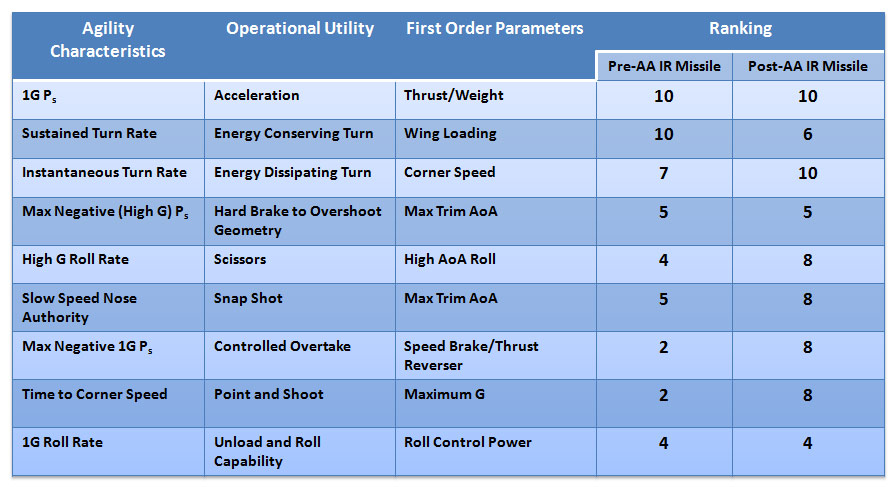
Air combat trends have expanded to ever increasing altitudes and speeds for beyond visual range (BVR) combat and conversely have tended to a lower and sometimes slower arena for close-in, within visual range (WVR) combat. … …This changing complexion of air combat, primarily due to the all-aspect IR missile, has altered the relative significance of the various performance characteristics with which we judge relative merit. Table 3 depicts the more common agility characteristics with some relative rankings.”
Time does march on, and so fighter and threat technology have progressed since 1985. So....

What About Today?

Regular readers will recognize this table from that earlier post:  

'Table 3' Reconstruction from “Advanced Fighter Agility Metrics

The authors of the original table and paper recognized the game changing aspects of being able to engage with missiles from 'all aspects' and those changes in their view re-jiggered the fighter maneuverability design priorities.

As I see it, this would be a two part mental exercise. First we need to add columns on the right side of the table identifying any 'game-changing' developments that would cause further changes to the rankings shown. Stealth is an obvious development, but are there others like "very-high off-boresight missiles". 

Before I put too much grey matter onto the project, I thought I'd open the floor for ideas, and then decide (collectively if there is interest) first what order and perhaps grouping the header(s) should be populated from left to right. I THINK the columns should be added in order of chronological developments, but I don't KNOW yet: I try to keep an open mind until info is in hand.

The end product of Phase 1/Question 1 would be the jumping off point for exploration of how these developments may change the relative rank ordering.  I think I'm going to solicit inputs from F-16.net board members in a thread of its own, but I would welcome an even wider range of inputs and insights.

Survey Question 1:
What has changed since 1985 that would affect the rank ordering scores that each 'Agility Characteristic' (as the term is used in the table) would receive? 


Reference:
ADVANCED FIGHTER AGILITY METRICS; Andrew M. Skow, William L. Hamilton, John H. Taylor; AIAA-A85-47027 

Saturday, June 24, 2017

F-35 Was NOT Inferior to F-16 in a 2015 "Dogfight"

Why Any Inference that the F-35 2015 'Post-Stall Agility' Control Law (CLAW) Test As a 'Dogfight' is Bogus

This is a rework of something I posted on twice in 2015. I'm doing the rework a a form of blog 'housekeeping'. When I wrote about it in 2015, the focus was on the echo-chamber, click-bait media claiming or inferring the CLAW test was a 'Dogfight' test. When I look back at that post, I now feel I buried the lede twice. The important bits were not how media tends to be F.O.S. for all their shenanigans (that's hardly 'news'), but the reasons WHY it was not a 'Dogfight' test, and that it can be clearly shown it was NOT a 'dogfight' test are.

Nowadays that the 2015 'controversy' seems to be a perennial word-count filler: something for the lazy media to put in a piece to 'balance out' any positive information about the F-35 in any article or story that might appear to be otherwise 'favoring' the F-35. I want to be very specific in what I am claiming going forward.

Assertion:  The event in question was a post-stall agility test, testing for areas where it might be worthwhile to 'open up' the control laws (CLAWs) and was not a 'dogfight'.

The 2015 Testing in Question was Described in 2014

Supporting Evidence:
The JSFPO and Lockheed Martin at the time of this faux controversy asserted it was a CLAW test. The assertion was met with much snark and derision from the professional cynics and F-35 Haters, yet that is exactly what the test was about. and it was described in a published technical paper by an LM engineer who should certainly know WTF the test was going to be about at the time he wrote the paper.

From the 2014 AIAA paper "F-35A High Angle-of-Attack Testing"[1], by Mr. Steve Baer, (Lockheed Martin "Aeronautical Engineer, Flying Qualities" at Edwards AFB), and presented to the Atmospheric Flight Mechanics Conference held 16-20 June 2014, in Atlanta, Georgia we find that F-35 High AoA testing was designed to follow in the following progression:
 "The test objectives for high angle-of-attack testing are as follows: 1) Characterize the flyqualities [sic] at AoAs from 20° to the control law limit regime with operationally representative maneuvers. 2) Demonstrate the aircraft’s ability to recover from out of control flight and assess deep stall susceptibility 3) Evaluate the effectiveness and usefulness of the automatic pitch rocker (APR) 4) Evaluate departure resistance at both positive and negative AoA with center of gravity (CG) positions up to the aft limit and with maximum lateral asymmetry. 5) Assess the handling qualities of the aircraft in the High AoA flight." 
Let's observe here that from the paper itself we can tell it was written while Objective #4 testing was ongoing and published at about the time it concluded. This observation is supported by the paper's passage [emphasis/brackets mine]:

With intentional departure testing [Objective #4] wrapped up, the team will soon move into departure resistance [Still Objective #4] and plan to remove the SRC now that these systems have been verified. In this phase of testing, the jet will test the CLAW limiters with much higher energy and rates than previous testing, fleshing out and correcting areas that may be departure prone. Lastly, select operational maneuvers [Objective #5], such as a slow down turn and a Split-S, will be used to gather handling qualities data on high AoA maneuvers. With the completion of this phase, the F-35 will be released for initial operational capability in the high AoA region. 
Note: 'SRC' is a 'Spin Recovery Chute'. 

Clearly the testing was not yet at step #5 at the time of writing but to emphasize same, the author followed the above paragraph with [brackets/emphasis mine]:
While the flight test team will explore legacy high AoA maneuvers for handling qualities, it will be the Operational Test and Evaluation team that will truly develop high AoA maneuvers for the F-35. In the operational world, a pilot should rarely be taking the F-35 into the high angle-of-attack regime, but the ability to do so could make the difference between being the victor or the victim in air-to-air combat.... 
So with this paragraph, not only does the author expound on the exploring of "legacy high AoA maneuvers" that is to come, he specifically identifies Objective 5 test as having "Handling Qualities" objectives and explicitly states that the kind of testing that will "truly develop high AoA maneuvers for the F-35" to the testing Operational Testers will perform later and excluded from the Edwards AFB Developmental Test Team activities.

In a nutshell, just within these two paragraphs that Baer wrote in early/mid 2014 is precisely what the JPO/LM stated in their official response to claims that the 2015 event involved some kind of 'dogfight'. Therefore the "reasonable man" may logically and confidently conclude the LM/JSFPO response:

1. WAS NOT simply something that was contrived in response to stories built around leaked program documents but...
2. WAS accurately asserting the truth about what the testing purpose truly was.

Now here we are two years later...


By next year and the roll out of '3F' software/capabilities I doubt if you will be able to find an F-16 pilot who has flown the F-35 that would not pick the F-35 over the F-16.

[1] AIAA #2014-2057

Saturday, May 06, 2017

We Can't let an F-35 Myth Die!

The "Phone it in Edition"

The only thing worse than 'phoning it in'.... is doing so with incredibly poor timing.

28 April 2017
“For me, it’s my first time dogfighting against an F-15”….“Dogfighting is a test of pilot skill, but it’s also constrained by the aircraft’s capabilities and I’ve been really impressed by the flight control and maneuverability of the F-35.”


 4 May 2017 click-bait regurgitation of an article first written in 2015 
“Close in, the JSF does not have the maneuverability of the Raptor––or even a F-16 or F/A-18.”


When Majumdar first started at FlightGlobal he showed promise. Alas, unrealized to date.

Friday, April 21, 2017

Eats, Shoots, and Leaves: F-35 Edition.

Punctuation: It's important.


There was a poor article published at Business Insider (as if that is a surprise) on 18 April where the author did a mashup of an interview of a retired USMC Major and F-35 pilot with a bunch of factoids, a few facts, and...well, let's just call it a lot of  'other than facts', such as repeating the lie about the 2015 CLAW test being a 'dogfight' and claims like.
The F-35A's mid-mission T/W ratio is better than 1 to 1, good enough to have pilots saying that at typical WVR speeds it can out accelerate an F-16. The F-35A's wing reference area is greater than an F-16 so one presumes he was talking about 'wing loading' -- which isn't a big deal if you've got the thrust to overcome it. I would still dearly love it if some enterprising journalist ever asked how many thousand pounds heavier the early production F-35A (AF-2) with instrumentation is than the first production spec weight target aircraft that was built several LRIPs later. Because weight matters.

What the pilot, Dan Flatley had to say was pretty good and consistent with all the other feedback from the people who fly the F-35 are saying. I think it should have been made clear that his views as a syllabus developer were in no way relevant to the JSF program process and pace in opening up the control laws (the very purpose of that 2015 exercise and publically known a year in advance), but the BI author seems to tie the two together more than the pilot does.

Everyone in the test program knew the control laws start out conservative for safety's sake and over time as the envelope is tested, the control laws get loosened to get all the 'safe' performance out of a jet that possible.  I'd also want some clarifications, but that need comes from the author's mashup. One has to read very carefully to keep from mixing up what the author asserts and the correlations he draws on his own with the interview: what was actually quoted as coming from the Major. The author doesn't have the technical chops to draw the correlations he does make (see thrust/weight ratio), and to me, unless you already knew what was going on, the article just muddies the waters.

Poor Writing Causes Even Poorer Writing

So as if that's not bad enough, we now have a sterling example of how perverted 'copypasta' will take  a poorly written article and turn it into a misquoted source. Compare the BI excerpt with an excerpt from a blogger posting opinions on the subject. Who the blogger is isn't important, what's important is what gets changed in the original story.

Now here's the copypasta:


Ignoring the highlights in the second graphic, do you see what was changed and how the entire meaning of the passage was changed with it?
.
.
.
(intermission)
.
.
.
In the original, Major Flatley states:
"If you try to fly it like the fighter it isn't, you're going to have terrible results."

In the copypasta, the blogger quotes Flately as stating:
 "If you try to fly it like the fighter, it isn't. You're going to have terrible results."

I hope there's no need to explain how, why, and what meaning has been lost in the translation there.

The blogger then builds a whole rant based on a misquote he made in the transcription. I do not believe this was intentional, at least I hope it wasn't. BI doesn't allow simple copy/paste using at least some browsers, including mine, so the transcription was probably manual and prone to human error. But I have to believe preconceived notions caused the mistranslation from one site to the next. Why?
To make that kind of error, it seems you would have to want it to be as you perceived it to even want to post about it in the first place.

Too good to check

The saddest thing is, I checked the comments (69 at the time) and not one person called the blogger out on the error. Almost certainly for most it was because the error reaffirmed their own world view, and the rest seemed to just take it at face value that the quote was legit and correct, whether they agreed or disagreed. This is how B.S. thrives on the web.

Note: I found the blog post with a search engine while looking for the BI article. It was at a site I used to frequent and my curiosity was piqued. Considering the time of night, I shouldn't have bothered in retrospect.

Monday, February 06, 2017

President Trump & The F-35: He's Done the Impossible!

F-35 Costs coming down as expected. Deal with it.
 
President Trump set wheels in motion that have turned the long-standing 'F-35 is unaffordable' deception inside out. The whole world now knows the F-35 unit costs are coming down exactly as planned and for -- as any honest person who's been paying attention already knows -- the same reasons the program has been citing all along.

How did Pres. Trump spread the word/change the narrative so quickly?
He leveraged the mainstream media's 'narrative priorities' and the lockstep and unthinking pursuit of narrative to suit their priorities.

Kneejerk Media PWNED

Thanks to the media's rabid dislike/disapproval of President Trump and ANY of his actions,

1. We now have outlets like the Washington Post shifting their 'all negative' cost narrative found in past F-35 reporting to finding themselves having to not only acknowledge, but ASSERT the costs were coming down anyway, and AS PLANNED in an attempt to deny President Trump any credit for same.

2. And when the media latched, again in lockstep, onto the "costs were already coming down" story, LM's CEO casually mentions 'but' the President DID help, if only by sharpening the negotiations' focus on 'Costs'.

Heck, since this started we even got James Fallow's/Atlantic Media's quasi-serious DefenseOne quoting ex-CAPE officials the week after they retired saying:
Over the past five to six years, the F-35 program “has performed pretty close to the [budget] estimates,”

My take

President Trump's involvement/interest has helped topple an information blackout and for now a Faux Military Reform Industry meme. I'm reminded of the old quote:

A man may do an immense deal of good, if he does not care who gets the credit for it. 
I don't care what people think about 'why' the unit costs are coming down as planned. I'm happy just knowing that people know they ARE coming down. Driving the media crazy over it is just a Trump side-benefit.

Sunday, January 22, 2017

This Fighter Program's Problems are Outrageous!

Time for another round of Name That Program!

(Any of this seem familiar?)
XXXXXXXX noted that:  
(1) XXXXXXXX has revised the XXXXXXXX flight test program by decreasing the data collection requirements that were originally planned; 
(2) program documents state that, although flight testing is behind schedule, program decisions to reduce test points will enable the XXXXXXXX to regain lost time and complete development testing in XXXXXXXX, as originally planned;  
(3) XXXXXXXX program documents identified numerous deficiencies relative to the aircraft's operational performance;   
(4) the most challenging technical issue is XXXXXXXX; 
(5) until these issues are resolved through software or hardware changes that have been adequately tested, the cost, schedule, and operational performance impact of resolving these deficiencies cannot be determined;

(6) the XXXXXXXX remains confident that it can correct these deficiencies;  
(7) in addition, XXXXXXXX that assesses risk areas in the XXXXXXXX program stated in XXXXXXXX, that operational testing may determine that the aircraft is not operationally effective or suitable;
(8) a XXXXXXXX preliminary operational assessment report, which is classified and based on limited data and analysis, identified 16 major deficiencies with the XXXXXXXX aircraft but concluded that the XXXXXXXX is potentially operationally effective and suitable;  
(9) the XXXXXXXX has consistently stated that the XXXXXXXX will be developed and produced within the cost estimates established for the program;  
(10) certain key assumptions on which the cost estimate was made have been overtaken by events;  
(11) program documents state that the current development effort is funded based on the assumption that problems would not occur during testing;  
(12) unanticipated aircraft deficiencies have occurred, and most of the program's management reserve has been depleted;  
(13) since the flight test program has about 1 year remaining, it is probable that additional deficiencies will develop;  
(14) correcting current and potential future deficiencies could result in the development effort exceeding the congressional cost cap;  
(15) the XXXXXXXX unit procurement cost estimates are understated;  
(16) these cost estimates were based on what has become unrealistically high quantities of XXXXXXXX aircraft that will be bought; and  
(17) more realistic assumptions indicate that, although the total procurement cost will decrease, the XXXXXXXX unit cost will be more than the XXXXXXXX currently estimates.


Answer below the fold. Drumroll.....

Saturday, January 21, 2017

'Opti-Onics': Arrived in the Late 20th Century


Via x-ray delta one we find the visionaries at Bell & Howell understood Intelligence Strike & Reconnaissance (ISR) way back in the 1940s :

Source: XRay Delta One (James Vaughan)
Just envision that's a 'Predator' or 'Global Hawk' silhouette we see looking down on the battlefield.

B&H is still with us-- somewhat transmogrified--too.

Thursday, January 19, 2017

B-2's Bomb ISIS!

H/T Edpop at F-16.net This is pretty much a repeat of what I posted at F-16.net

It is interesting that CNN focuses on the body count.

It does gives proof to the old adage "If it bleeds it leads' but my, how 'Southeast Asia 1965' of them.

What's more important: Were the right terrorists killed. This is pretty much a repeat of what I posted at F-16.net

Q: Why use B-2s?
A: So ISIS never saw us coming.

Q: Why 2 B-2s to drop 38 weapons when 1 can carry 80 500lb JDAMs?
A: To bomb both locations at the same time, like probably down to the last second unless they wanted to cause a response in one first by bombing the other. And more than 38-40 would have probably been overkill.

Q: Was this cost-effective?
A: Aside from killing the terrorists who would have carried out attacks in Europe and probably elsewhere now and later (CNN and their 'militants'....F*! both.) it probably:
a.  flattened their training facilities, weapons building capability and stockpile and the trainers of future terrorists,  
b. it will also make the survivors look up in the sky at night and loose their beauty sleep.
The immediate and later costs of letting any attacks happen probably far outweighed the cost of flying 2 B-2s and expending a few bombs.

There are some less obvious positives about this, given the 'international' interest in the region, but I will not air them here.

Now  expect some slacker in the media to use the 'kitchen sink' definition of $/FH to rail against the strike as 'wasteful' in 5...4...3...2...

On a personal note...

I had a very small role in fielding the Smart Bomb Rack Assembly (Smart BRA: gotta' love it). I suppose since they dropped only 38 JDAMs they could have used the Rotary Launchers (RLAs) but that's OK too, since I also played a small role developing and testing the smart weapons interface that allowed GATS/GAM then JDAMs etc. to be dropped as well.

I feel pretty good about all that right now.

Updated 20 Jan 17: Well now the reports coming in say 'over 100' JDAMs, and some specifically assert 110 JDAMs were dropped in two camps. It appears by some accounts there were to be up to four camps targeted initially but the terrorists had consolidated as well as relocated between the time the missions were conceived and executed. I'm sure the AF still enjoys it when targets bunch up. 
It would have been hard to move assets around the Middle East to hit Libya like this without contrarian interests leaking it beforehand, I still remember Operation Allied Force and how ops departures out of Comiso seemed to be on TV in real time. The message here is: you won't see us coming unless we want you to.   

As it perhaps looked like a last tasking from Former President Obama to our enemies, I imagine they were just as surprised as some of the media appear to be when a Buff and UAVs took out a few AlQaeda in Syria in followup

Friday, February 26, 2016

Northrop Grumman's B-21 Bomber Concept Revealed

Newly released B-21 unclassified computer art? Deja Vu Baby!

The artist's concept revealed by the Air Force for the newly-revealed B-21 "bomber" (will that moniker survive or will it become something else when it is all said and done?) is "Deja Vu all over again". Cool.

Contrast the B-21 computer sketch just released:

...with the first artistic rendering of the B-2 for public release:
  

Someone has a sense of humor...and history.

Note the similarities between the two in what is obscured and what is revealed. Both illustrations mask the exhaust design completely and 'shadow' the aft window areas. The B-2's debut drawing had more details shown for the intakes, but there may not be any details to be masked in the B-21's design....or some interesting details left out perhaps?

Both illustrations give ZERO indication of what the underside shape or volume may be. The B-2's leading edge rendering gives a hint to what had become one of its most critical design features: the 'toothpick' leading edge (P.64). I do see something that I find kind of surprising in the B-21 illustration (not going to say what it is until maybe after I talk to some folks) but I wonder now if there's a critical design feature hinted at here that will only come out in time just like the B-2's 'toothpick'?

I'll let our potential enemies' minds boggle over the possibilities. I'll also just enjoy the possibility that the data from original B-2 high-altitude design optimization seems to have come in handy for Northrop Grumman in preparing their winning design.

Minor Snickers

1. So much for all that cranked-kite speculation eh?
2. The conspiracy nuts are going to have a field day with the revelation there has been no prototypes built.    

Monday, February 15, 2016

GAO's LRS-B Findings Tomorrow?

Tomorrow was the planned release of the GAO's findings on Boeing's LRS-B contract protest. It technically is two days later than the required timeframe/due date, but the deadline was on Sunday and today was a Federal holiday. Will the tempest-in-a-teapot over someone's second-hand ties to a Northrop (or Northrop Grumman) pension that emerged last week delay the announcement? I think it would be pretty silly for it to cause delays, since the person involved had nothing to do with the source selection: he was THAT guy's replacement AFTER the selection was made.

But we live in the 'stupid era' and lawyers are involved. 

What wouldn't have raised an eyebrow a couple of decades ago will set off a storm of controversy because...well because the coddled, noisy elements of society are particularly ignorant and easily manipulated these days and soapboxes have never been so cheap.

Standing by......

FYI: GAO's findings, whatever they are, are not binding on the DoD. But if the DoD wants to go against them, it will require varying degrees of political capital to be spent. Should be interesting... if it is not boring...when the news is finally let out.

Tuesday, October 27, 2015

Faux Reform's Camel Already Has Her Nose Under the LRS-B Tent

The Faux Reform Crowd are hilariously heavy-handed. May it ever be so.

Embedded in the bottom in an otherwise very fine article at Breaking Defense about Northrop Grumman winning the LRS-B contract we find this nugget from Rep. Jackie Speier (D-CA):
“We need to keep the Long-Range Strike Bomber on track and hold the Pentagon to its promise of delivering a tested, reliable airplane for $550 million a copy [in 2010 dollars],” Speier said in a statement. “The Rapid Capabilities Office has made some good decisions to use proven technology and accept the recommendations of independent weapons testers and auditors in their development process. But there are warning signs, including a clerical discrepancy that resulted in a $16.7 billion misreporting error to Congress.”
(I suspect this and the oblique 'emerging critics' reference early in the piece were Sidney's contribution. He likes to cite politicians as if they are soothsayers.)


LOL! Well THAT didn't take long. 

A clerical error, in only one of many documents, on a number everyone knew beforehand, and was corrected as soon as it was noticed, after being so out of place it was noticed quickly is a 'warning sign'? I got Jackie's warning sign for her right here: It's called the revolving door between faux military reform operations and Prog legislators teamed in a pernicious self-licking ice cream cone with Punk Journalists That IS the "Faux Reform Message Machine".
I could take these people if they were honest with their arguments, but if they were honest with their arguments they couldn't stand the laughing.
Mmmmmmm. #SmellsLikePogo

Sunday, October 25, 2015

Twisting F-35 Factoids to Spread Untruth? I Smell POGO

The F-35 Ejection Seat Non-Story Self-Implodes on its Own Ignorance and/or Deception

Alternate Subtitle: “Do I now have to start checking my Twitter feed more than once a month or so?”

Back on the 15th, the faux military ‘reform’ F-35 Ejection Seat narrative got a boost in circulation when it hit the Political website ‘Roll Call’. The author clearly didn’t understand what was or was not important on the subject of ejection seats, and quite frankly, the story RC was pedaling wouldn’t hold up to even the most casual review by anyone who has ever been AIS (A**-in-Seat) in one while “slipping the surly bonds”… or worked on or around them while on the ground…or worked/trained in aircraft safety or reliability. When the meme first emerged in a DefenseNews story on October 1, I thought at the time that the story’s timing and meme might be a POGO aka ‘Straus Military Reform’ disinformation piece. Given the machinations to keep the ‘story’ going in spite of its idiocy being proffered, I am now even more convinced of same.

This post WAS going to be a straightforward point-by-point ‘fisking’ of the faux F-35 seat story as breathlessly reported at Roll Call, but the story became so bizarre in the spreading of it—and the speed of it--that the story had pretty much fisked itself before I could take the time to do it for you.


Does Ignorance or Ideology Inhibit Defense Reporting?

Yes. Next question?

I didn’t (still don’t) have time to completely disabuse all of the people who reported all of this drivel as ‘revelation’. At most it could be called a ‘realization’...that those reporting are ignoramuses when it comes to system and flight safety, fighter aircraft design, risk management, and apparently ‘technology’ in general. 

The author of the Roll Call piece linked above got the bit in his teeth over the other ‘story’ linked to above that was first written up by an seemingly earnest 'noob' at Defense News named Lara Seligman and a guy named Aaron Mehta.
Mehta is someone I’ve had on my ‘faux military reform’ radar for a little while. Mehta’s moved from being someone who produces shaky policy pieces for a so-called ‘good government’ non-profit attempting to influence defense policy to now 'reporting' often on non-profit policy pieces posing as news in defense media.

Where's Mehta fit in? Where does Donnelly? We'll have to just keep watching for now.
 The creative use, abuse, and misinterpretation of what the facts in hand (and those missing) ‘mean’ are what makes the whole F-35 Ejection Seat/Helmet ‘story’ reek of the typical output that comes from the POGO/Straus ‘P.A.C.E.’ generator. While one might get the same writing result that we've seen simply by not knowing WTF one is writing about, one wouldn’t then subsequently double-down on the stupidity when called out on it in the comments. If you count the incremental updates to DefenseNews articles along with the subsequent new stories there and elsewhere, you could make a case for the faux military reform message machine having ‘triple-quadruple-downed’ as the participants have progressively dug their rhetorical heels in on ‘THE STORY!’.


The Roll Call 'Story'

As good a place as any to begin deconstructing the idiocy spreading around the web is with John M. Donnelly’s 19 October Roll Call piece. My favorite hyperbolic bit in the Roll Call ‘story’, one that pretty much defines the nature of the 'journalistic' problem we are dealing with was:
“…pilots are rotated backward into a position where they face all but certain death from the rocketing parachute's force snapping their heads…”.
Really?

Ahem. Philosophical Fighter Safety Tip O’ the Day:
IF you are ejecting, you are already facing “all but certain death”.
Anyhooo… I tweeted in a couple of places that this story smells like POGO, and then posted this comment over at F-16.net:
I may find the time to go into more detail on this someplace else, but there are several notable things about this story, and none of them have to do with what is being said right now.
The first thing is that none of the numbers being tossed about indicate what the DIFFERENCE is between legacy (including ACES II) systems and the F-35's MB seat. ALL ejections have serious risks involved which is why they generally only occur when the aircrew determine the risks of staying onboard are greater. 
The second thing is that the some of the lower concern weights are outside ANY measured probability of survivability for ANY legacy systems. Those seats were for a much narrower percentage of body shapes and sizes.
The third thing is that unlike legacy systems, the F-35 seat is designed for a 'kinder-gentler' ejection to make the seat safer for women of ANY weight at ALL ejection speeds. The greater S-curve of the female spine makes it more prone to 'snapping' with the more violent extraction of older seats. So this also means the average male pilot cannot leave the plane as fast as he used to even if it is more advisable....because EQUALITY!

The last thing I have time to talk about here is that this non-story had all the feel of a POGO fueled P.A.C.E. attack. And I suspect it now even more after checking the self-licking ice cream cone at play in Donnelly's Twitter feed.
Only thing missing is the likely e-mail, phone call or text that POGO's "Straus" operation fed him in the first place. I created a hashtag for this kind of crap. If you tweet (I've only played with it) and find this story elsewhere, retweet with #SmellsLikePOGO or #SmellsLikePogo (I covered both punctuations JIC).
I had tweeted Roll Call’s Donnelly piece thusly:


Little did I suspect at the time that Donnelly would even bother replying with:

Which I only know about from the e-mail notification. For by the time I noticed the email and followed the feed, Donnelly's response had-- oddly enough--'morphed'.

It’s always nice to have context to subvert an anti-defense faux-reform meme handed to you with the meme.

My first thought from the initial RC response was: Hey! I know that statistic—I HAVE the report it came from (a DoD IG report #2015-090).

My second thought was:
He should probably have somebody explain it to him. Somebody who knows something this time.
The IG report referenced in the tweet that was dumped down in the memory-hole  IS EXTREMELY helpful, but probably NOT in the spirit in which it was invoked.
The report has some great background and references, most of them are publicly accessible. This stuff is useful for several reasons addressing problems with the false 'F-35-Ejection-Seat-as-Greek-Tragedy' narrative in several areas.

First,collectively the documents are of great benefit to help us scope the magnitude of the ‘Ejection Safety’ question itself.
Secondthe report clearly identifies the expected performance and ejection limitations of existing ACESII and NACES seat systems for a variety of aircraft when using helmets with just some of the devices and capabilities that are already built into the F-35’s helmet. Per the report, the ejection safety performance of existing systems (Pgs. 14-16) turns out be at best equal and in some ways worse than the F-35 system with the F-35 helmet design: as it now exists.
Legacy systems cannot now, nor have they EVER been able to support use by an aircrew member weighing less than 136lb, so the fact that the F-35 system won’t either at the moment--while it is still in development--is hardly a scandal or even 'news'. It would be ‘news’ for about 5 minutes if it looked like it couldn’t be done, then I suppose someone could turn it into a ‘scandal’ if there was evidence of no wrongdoing being wrong-done.
But there isn’t any indication of same, so…………where’s the story? Going beyond the small aircrew restrictions common to all the modern systems, is there any 'there' there that makes the F-35 ejection system unnecessarily more dangerous than legacy systems? The DoD IG report provides some dreaded context ought to send the purveyors of Too Dangerous F-35 Ejection meme scurrying. Not that it will, just that it ought to.

Per the IG Report, one current ejection system combination (Pg. 17) has a lower maximum safe ejection speed limit than the F-35’s current limits. We also learn The Air Force is working on certifying a new ACES system that will probably be retrofitted into legacy systems, and quite frankly it wouldn’t surprise me to find out in the future that this faux ‘issue’ isn’t also being promoted in one way or another by unidentified promoters of the improved ACES system. Don't know if there are such forces at work, just know it wouldn't be surprising given the specifics of the DefenseNews unnamed 'expert' statements.

Third, the DoDIG report provides very important references where we find ejection survivability standards and it places terms like ‘serious risk’ and ‘unacceptable risk’ within some actual framework of meaning. Perhaps the most important key paragraph for slapping down this whole F-35 ejection risk scare-fest is found in the last paragraph of page 16 of the DoD IG report:

Using MIL‑STD‑882E, which defines the safety risk acceptance process and assuming that a major or fatal injury would be designated as a catastrophic consequence, the probability of occurrence would be identified as a 1D (catastrophic/remote). This level of risk is usually accepted by the program management office; in this case the aircraft Program Executive Offices.

The PEO for the F-35 has accepted the risks for pilots weighing more than 136lbs. Those familiar with the risk assessment and risk management processes can probably envision what the categorization "1D" actually stands for, but it will be helpful to place it in proper context for the rest of the world by showing why and how ejection risks and category "1D" are positioned among all the other categories within the System Safety construct.

Here is Mil-Std-882E (current release) Table 1: Severity Categories.
Since an ejection can ALWAYS result in ‘death’. There can only be ‘Cat 1 Severity’ involved in ANY ejection. So the next variable of interest for us is now within the probability side of the equation. As seen in Table 2 from the same Mil-Std-882E we find:
So then, what else COULD any ejection be other than a Level D category of probability?

Answer: There isn't one. 

Each ejection seat gets one ride outside the airplane, and each airplane only gets one ejection maximum in its lifetime (duh!). You can’t say you can assume it will never happen, and you sure as he** don’t design airplanes such that ejection system use would be ‘likely’.

Bottom Line: Category 1D is both the best you can do, and the worst you can accept for any ejection system.

This means there is always “Serious Risk” (as the Mil-Std-882E matrix above shows) involved in ANY use of any ejection system. Since it is always true, then it is hardly ‘news’ is it? (But 'Serious Risk!' DOES make a great punk-journalism hook for a politically fueled “hit piece”, eh?)

If you want to get really silly about it...

We could drill down even further into the data available, and ignore the fact that the F-35 ejection system is still being ‘worked’ to make it as safe as it possibly can be (the ‘requirement’ remember?). If one is so desperate to find an F-35 controversy that one would now debase themselves wallowing in the minutia and splitting hairs about WHERE in Category 1D the F-35 system currently lies relative to the legacy systems for pilots weighing more than 136 lbs, that’s easy enough to do to get an idea if they are at least of the same order of magnitude.


Assuming Gen Bogdan’s statement in testimony this week where he said that every time a pilot steps to the plane his risk of neck injury during ejection is “1 in 200,000” meant he was saying a serious neck injury or death would occur (he could have meant even minor neck injury), and that an average mission would be an hour long, this is how it stacks up against the AVERAGE legacy numbers the the DoD IG came up with for many different aircraft for the Navy (F-18 variants) and the Air Force (listed in report on page 6), then the comparison would look sort of like this:


There’s a lot of ambiguity in the figures in the report that prevent any direct comparison of history with any future risk calculations. First, these legacy numbers from the IG report are DoD IG calculations from 20 years of ejection history: they are the 'rates experienced' and not the product of a statistical analysis of all the risk factors involved.

We must also assert quite a few important caveats for using these numbers in any comparison to be made against future risks. Off the top of my head, some of them are:
1. The DoDIG numbers are ‘averages’ for many different aircraft/seat/headgear combinations, so there will be a range of values for each aircraft type by user within the average provided that we have no visibility into as to variations within the sample set and what if any correlations exist that would affect any comparison with other data. Just look at the variance between USAF and USN numbers for an example of variance even within the history.
2. The number of events--even over twenty years--is extremely small given the flight hours flown. If like a pair of dice is rolled for one outcome, even if the next ‘roll’ could be made under identical conditions, it probably would have quite a different numerical outcome, just not one that varied in any statistically-significant way. For an ejection, the factors are many, the combinations and permutations are astronomical. You should expect gross numbers to vary grossly.
3. The number of ejections that occurred over the past 20 years, the type and combinations of injuries and causes include those ‘induced’ for reasons other than the system performance, including human error, and all of them occurred in a combination of operational environments and event conditions that cannot be exactly replicated. The future will be different. We can only guesstimate by how much.     
4. These numbers are very small, and official risk analysis yields similarly other very small probabilities. Any time we are dealing with very small ‘long-tail’ probabilities it is important to remember the confidence in those same probabilities goes down. I suspect this is the reason that one comment from the Air Force System Lifecycle Management Center (pg. 33) that asserted the past could be used to predict future ejections was not included in the report (not just journalists have problems with statistics).
There's more but I don't want to belabor the point for the small return on the effort. Now remember we also don't know the actual number Bogdan was referring to with that nice round 1 in 200,000 probability, and what the actual boundaries are of the phenonema falling under his defintion. I suspect the number he used included minor neck injuries as well since he flatly stated 'neck injuries', but even assuming the worse, the round prediction number Bogdan used falls somewhere between the USN and USAF 'major injury or death' categories for all forms of injury that occurred in the past.

Conclusion: 
We just went through a lot of la-di-da navel gazing just to observe that 'yes the predictions and the history of risk appear to be about the in the same 6th significant digit order of magnitude'. Any bets there still will be people who will try to claim the variation between the two is 'significant'? There's always somebody. Tell them get all the numbers they need to actually conclude something, but until then to STFU.     

Bogdan Testimony Sidebar: FYI and BTW, the Congresswoman asking LtGen Bogdan the fumbling question about survival odds and who introduces the news 'report' claims that we've been dealing with here into the hearing is none other than the current POGO/Straus Military Reform Project director's last employer. Rep. Jackie Spieirs (D-CA) had employed Mandy Smithberger as a staffer just prior to Smithberger returning to POGO/Straus to take over the reins from good ole' Winslow Wheeler. That would appear to very nicely close the loop on the Scary F-35 Ejection story's purpose and intent. Just another reason this Smells Like POGO. I want to know more about the 'revolving door' operation being run out of POGO, don't you?

Fourth and finally, the DoD IG report itself, released just earlier this year, makes the VERY important and explicit point about not ‘evaluating’ the F-35’s ejection system at this time because it is still under development. A point that apparently NONE of the handwringers so far has thought was important enough to give them pause in their little 'group writing project'.

If Schrödinger had been a fighter pilot, we would have never heard about his cat.

Now, here we are in the warm-afterglow of the sub-committee hearings, and the meme being pedaled seems to have shifted to journalists and progressive pols know more about ejection risk, and risk in general than those who do this stuff for a living'. Which is extremely funny. 

The critical phenomenon under examination is not the probability of an aircrew surviving an ejection once initiated. It is the probability of an aircrew surviving the mission, each and every mission. The probability of surviving each and every mission means surviving an ejection as a subset of the critical phenonemon must involve at least TWO* probabilities.  The first is the probability you will need to eject in the first place, and the second probability is the probability you will or will not survive the ejection event. The second probability is called a 'conditional' probability. Neither the probability of survival or probability of perishing during an ejection actually exist (estimates are not 'existence') unless and until the need for ejection occurs in the first place. 
It is irrational to focus on the risks incurred only after an ejection is underway and ignore the probability of the need to eject. The probability of survival depends on both, and each are meaningless (to the pilot the most) without the other.      

*We can eliminate considering all prior variables if we assume the pilot gets in the plane and takes off in his ejection seat-equipped airplane in the first place.  

Any risks that are calculated (versus known or proven) and weighed as being acceptable or unacceptable are just a contributor to some overall aircrew survivability standard that cannot be exceeded. Within the overall survivability standard, the requirement is merely to design the plane to make the ejection as safe as possible, because as we have already observed, it is impossible to make it ‘safe’ in terms the average man-on-the-street envisions safety.

Bonus material

History Charts
I repackaged some of the ejection safety history found in the DoD IG report, just so I could look at it from different angles. Note the wide variety of the internal data between AF and Navy operations in the report affected how I viewed some of the rollup stats here. No conclusions to draw from it, just observations. Enjoy.


About that DoD IG report...
The report itself is a product of Congressional hand-wringing over HMD(evice) equipped helmets. The DOD IG’s “Objective” was to determine:
…whether DoD aircraft ejection seats meet aircrew survivability and equipment airworthiness requirements for pilots and aircrew wearing helmet‑mounted displays (HMDs), night vision goggles (NVGs), or both during flight operations.”
The important finding to this objective:
“DoD ejection seat equipped aircraft with aircrew wearing HMDs and/or NVGs meet airworthiness criteria in accordance with DoD Military Handbook 516B, “Airworthiness Certification Criteria,” (MIL‑HDBK‑516B) and have been certified safe‑to‑fly by the appropriate Navy and Air Force acceptance authorities. However, both Services noted that there is an increased risk of neck injury during high‑speed ejections with HMDs and/or NVGs above 450 Knots Equivalent Air Speed (KEAS), and an increased potential of neck injuries for low‑weight pilots. To mitigate these risks, both Services placed warnings, notes, cautions, and restrictions in the flight manuals.”
The rest is about ‘updating the paperwork’, philosophical questions about the flexibility to operate in a responsive manner under handbooks and guides vs. one-size fits all mandates, etc.

The really interesting thing in the report is the back and forth between the agencies involved. The report is better with the responses incorporated, and one can see where the IG report would have gone awry without those responses. It is interesting to see what responses were incorporated, and which were not. There were a few points the safety guys made that the IG report authors blew off (best one: people rarely have time to remove devices from existing helmet systems when required for ejection.) 

There are some odd turns of the phrase in the report as well. Things like "unfortunately" there not being any lightweight pilots who have had to eject in the last 20 years.

Additional reading:
In any of the media reporting on F-35 and other helmet weights, the subject of how that weight is distributed rarely comes up, yet the effect on the balance of helmet when devices are attached is a very important factor (See here and here for examples) and the F-35 helmet design has a far better weight distribution than legacy systems and is therefore more ‘comfortable’. This better balance would suggest the F-35 helmet is a probably a safer helmet at the same weight and possibly even at a slightly higher weight than legacy systems. Time and data will tell.


Sunday, August 09, 2015

“Fighter Aircraft” Design: Driven by Operational Requirements


Part 1: Introduction

In the wake of the disinformation cascade set off by the mischaracterization of an F-35 Developmental Test report leaked to the poster-boy for Punk Journalism (and his equally hapless compadres) it became apparent that somebody, someplace should highlight just how infantile all the F-35 H8er and click-bait copycats have been on the subject.

Since ‘Axe is Boring’ ‘broke’ the story (if you can call being hand-fed the raw data by some other cretin and then making sh*t up about things he doesn’t understand ‘breaking’), I think we’ve seen every perversion of reality about the test itself, the relevance of the test, the F-35’s capabilities, the history of air combat, ‘dogfighting’, and airpower-in-general trotted out and gleefully regurgitated as if it were gospel by the innumerate and the illiterate.
As creative as the fiction published about the aircraft (it was an early production 'A' model: AF-2) performance during  the Developmental Test has been, it seems most if not all of the F-35 criticisms related to the ‘leaked’ test report fall into two broad categories. In the first category we can place all the claims/accusations that the F-35 is not somehow ‘fighter’ enough to successfully engage in air combat. In the second category we can place all the assertions that the scenarios flown in this one test were representative of how the F-35 would perform Air Combat Maneuvering aka ‘Dogfighting’ in actual combat.

We will deal with both these strains of criticisms in what will be Part 2 and Part 3 respectively within this short series. In Part 2, we will recall a rather cogent, insightful and in many ways prophetic AIAA paper from 1970s: “The Characteristics of a Fighter Aircraft”. This paper is the text transcript for the Wright Brothers Lectureship in Aeronautics speech given by Prof. Gero Madelung (speak German?) to attendees of the annual AIAA Aircraft Systems and Technology Meeting in 1977.  I’ll then introduce the thoughts on fighter development from a very influential and widely-cited engineer (among aircraft design types anyway) who among other things can be considered the originator of the concept ‘supermaneuverability’.  Thus, Part 2 (which may have to be broken into sub-parts if it gets too unwieldy) will bring us up to speed on top-level ‘fighter’ aircraft design drivers right up to the present-day state-of-the-art, and maybe a peek or two at the future.

Whereas Part 2 will provide proper background and perspective, Part 3 will be where the perspective will be applied and so will be more ‘analytical’. We will break down a 1 vs. 1 air combat scenario into a high-level conceptual model of constituent phases and associated combatant states. Then we will apprise the F-35’s potential advantages and disadvantages at different points of reference during engagement scenarios as it moves into and out of those phases and states and under what conditions it can navigate its way through those phases and states. We will also weigh the relevance of those advantages/disadvantages to possible combat outcomes.

Part 3 will take some time to complete after Part 2, so I will ask the readers to bear with me on any delays, or perhaps I will invite comment on aspects of the approach to Part 3 as I build the conceptual model. We should not have to account for probability of outcomes and only illuminate the ‘possibilities’ for discussion-- which will simplify the problem significantly but not to the point that careful construction will not still be necessary just to avoid oversimplification on the one hand or sophistry on the other. This is the hard part of Part 3: to make complete enough to be valid and convey meaning, not so complete that too many eyes glaze over. The topic would be a lot easier for me to treat if there were more authorized references to the F-35’s Developmental Test that I could tie into, but we’ll muddle through without them somehow.

This is also probably going to seem awfully obvious and trivial in many places to some, but I want to have a single reference to point non-technical minds to in the future. -- Because this is one of those topics where you could get worn out just beating down the same stupidity and misperceptions every time they pop up.
Finally, in each part I will include a reminder:
NOTE:
Nowhere in this series of posts, or in any other posts the reader will find here, is the assertion made that ‘maneuverability’ (however one defines it) is "unimportant"-- in the past, modern day or immediate future . This must be stated unambiguously up front because I've seen the tiresome broad-brush accusation of same made too-often when anyone dares challenge some closely held belief as to maneuverability’s relative importance to fighter design or dares challenge the vague reasons why many of the uninitiated think “maneuverability” is important. 
This note won’t stop tired criticisms from arising, but it will make intelligent people stop and think before they paper any comment thread with false conclusions. And this series of posts isn’t for the people too stupid to know better anyway.

Part 2 is here